Designing for Inclusivity: Multi-Language & Multi-Device Immersive Learning
Designing for Inclusivity: Multi-Language & Multi-Device Immersive Learning
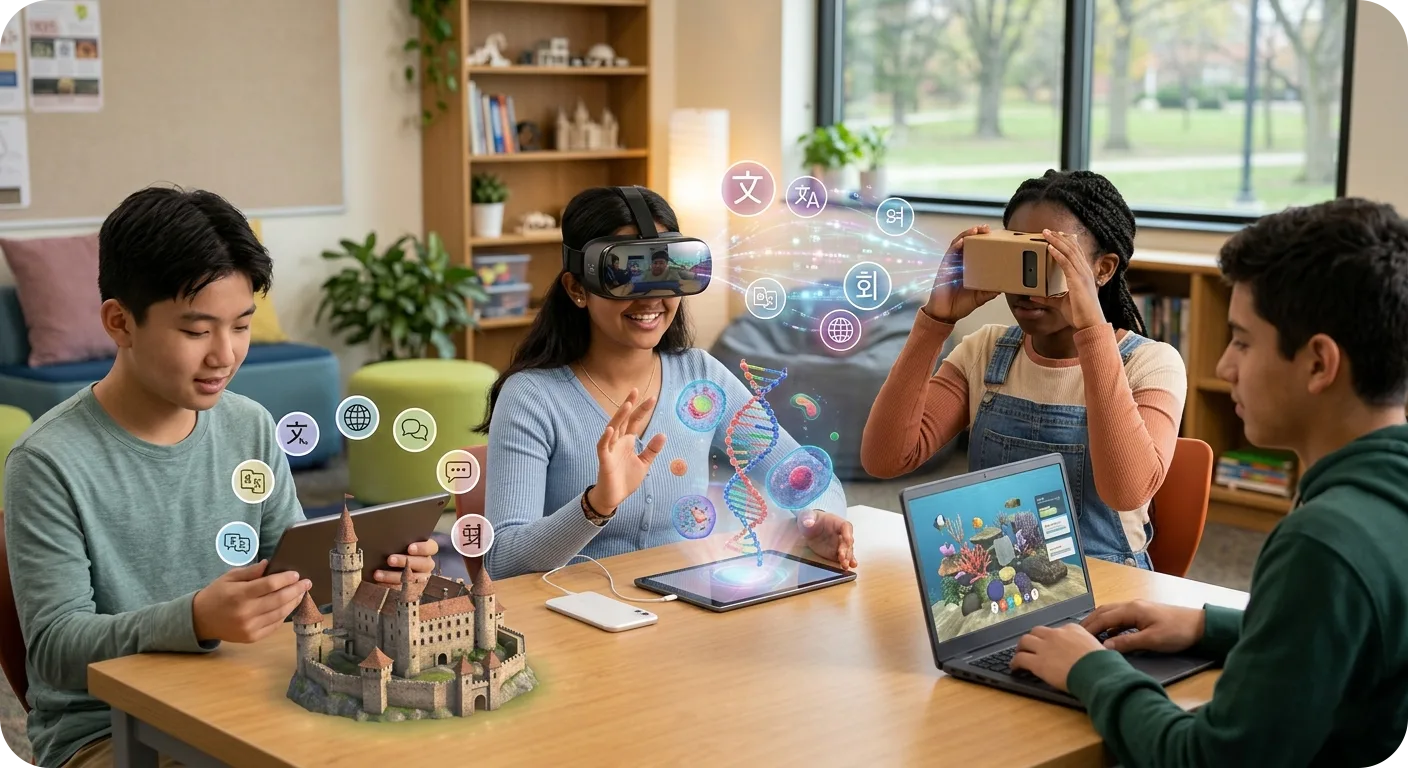
Immersive learning is often associated with expensive VR headsets, powerful gaming computers, and high-speed internet connections. Many people assume that advanced educational technology is only possible in premium schools with large budgets and modern infrastructure.
But the future of education cannot be built only for a small percentage of students.
If immersive learning is truly meant to transform education, it must be designed for everyone - students in urban schools, rural classrooms, low-bandwidth regions, and multilingual communities alike.
At VidyaXR, inclusivity is not an additional feature. It is the foundation of how we build educational experiences.
We believe every student deserves access to engaging, interactive, and visually rich learning experiences regardless of their device, internet speed, or preferred language.
Why Accessibility Matters in Modern EdTech
Technology has the power to reduce educational inequality - but poorly designed technology can also increase it.
Many EdTech platforms unintentionally create barriers:
- Heavy applications that require downloads
- Large data consumption
- Dependence on expensive hardware
- English-only interfaces
- Limited support for low-end mobile devices
- Poor optimization for slower internet networks
For millions of students, these limitations make advanced learning tools inaccessible.
A student using an entry-level smartphone on a 4G network should still be able to experience high-quality interactive education without frustration, lag, or expensive setup requirements.
True innovation in education is not about creating technology for the most advanced users.
It is about making advanced learning available to the largest number of students possible.
Optimizing for Standard Hardware
One of the biggest challenges in immersive learning is performance.
3D simulations, AR experiences, and interactive scientific visualizations are usually resource-intensive. Without optimization, these experiences become slow, difficult to load, and unusable on standard devices.
To solve this, we focus heavily on lightweight architecture and performance optimization.
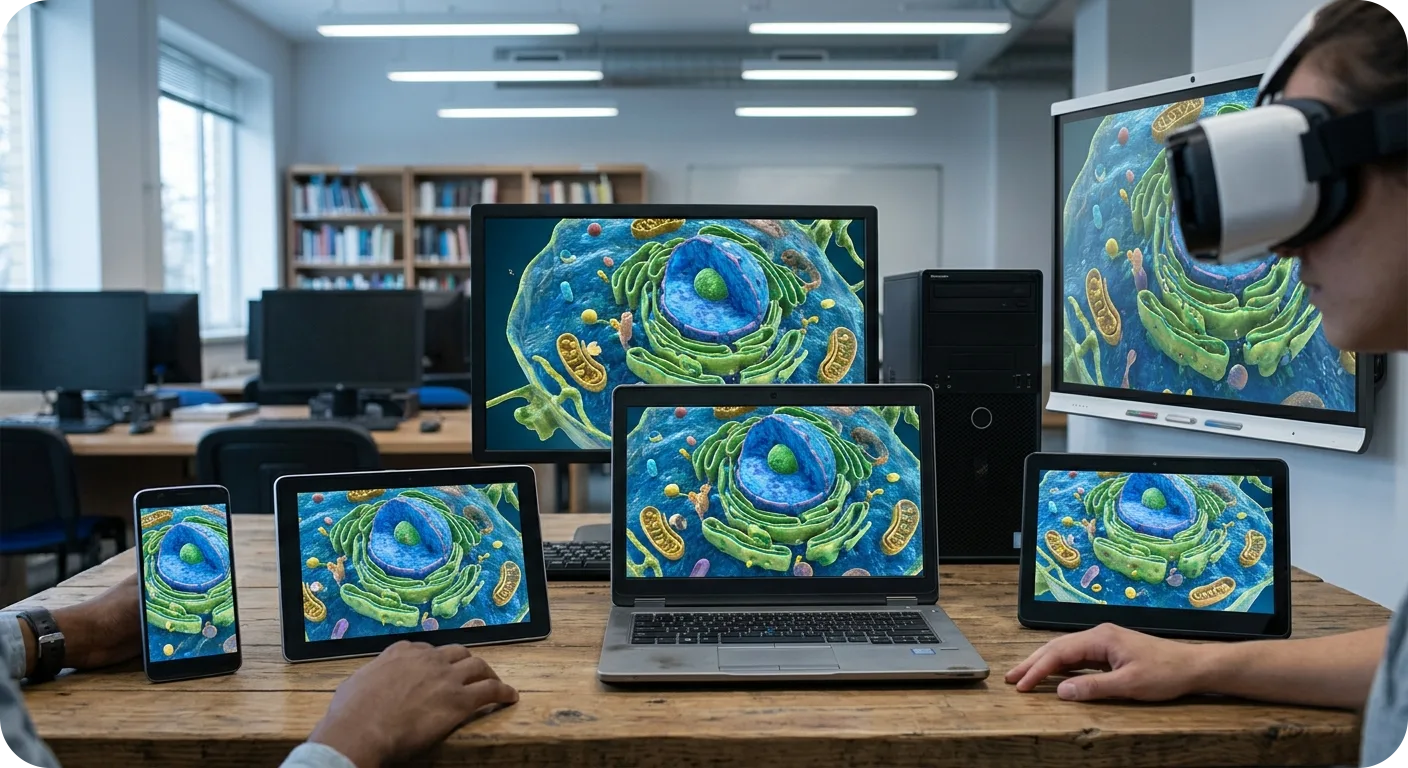
Our platform is designed to run smoothly across:
- Budget Android smartphones
- Tablets
- Laptops
- Desktop browsers
- Interactive displays
- VR-compatible devices
without requiring high-end specifications.
Key Optimization Strategies
1. Browser-Based Learning
Students can launch modules directly from a web browser without downloading large applications.
This removes several common barriers:
- No installation complexity
- No app-store dependency
- Faster access to learning
- Lower device storage usage
- Better accessibility across schools and institutions
A student can open an immersive biology simulation with a simple link and start learning immediately.
2. Lightweight 3D Asset Compression
Immersive learning content often includes complex 3D models, animations, and environments.
We optimize and compress these assets carefully so they load efficiently even on slower networks like 3G and 4G connections.
Benefits include:
- Faster loading times
- Reduced data consumption
- Smoother interactions
- Lower memory usage
- Improved mobile performance
This ensures students spend more time learning and less time waiting for content to load.
3. Cross-Device Compatibility
Students today learn across multiple devices throughout the day.
A lesson may begin on a school desktop, continue on a tablet during travel, and finish on a mobile phone at home.
That’s why seamless cross-device compatibility is essential.
Our immersive experiences are designed with responsive layouts and adaptive rendering systems that automatically adjust based on the user’s screen size and hardware capability.
The goal is simple:
Provide a consistent learning experience everywhere.
Breaking Language Barriers in Education
Accessibility is not only technical - it is also linguistic.
India alone has hundreds of languages and regional dialects. Yet a large percentage of educational technology still relies primarily on English.
This creates a major challenge for students who understand concepts better in their native language.
Research consistently shows that students grasp complex topics more effectively when explanations are delivered in their mother tongue.
That is why multi-language support is a critical part of inclusive learning design.
At VidyaXR, we are building experiences that allow students to switch seamlessly between:
- English
- Hindi
- Regional languages
- Localized educational terminology
This helps learners understand difficult scientific and technical concepts with greater clarity and confidence.
Why Mother-Tongue Learning Improves Understanding
When students are forced to mentally translate information while learning, cognitive load increases.
Instead of focusing fully on the concept itself, part of the brain’s effort goes into language processing.
Immersive learning becomes dramatically more effective when:
- Instructions are localized
- Scientific terms are contextualized
- Narration is language-friendly
- UI elements are translated naturally
- Interactive guidance feels familiar
For example, a student learning human anatomy in their preferred language can focus directly on understanding organs, systems, and functions instead of struggling with unfamiliar terminology.
This improves:
- Concept retention
- Classroom engagement
- Learning confidence
- Participation levels
- Long-term comprehension
Designing for Low-Bandwidth Environments
Many students around the world still experience unstable internet connectivity.
Educational technology should not fail simply because the network speed drops.
To address this, immersive platforms must be engineered intelligently.
Important considerations include:
- Efficient streaming
- Progressive asset loading
- Low-bandwidth rendering
- Smart caching systems
- Adaptive media quality
- Reduced dependency on constant connectivity
These optimizations make immersive learning more reliable and accessible for underserved communities.
Inclusivity Creates Better Learning Outcomes
Inclusive design benefits everyone - not just students with limitations.
When software becomes lighter, faster, multilingual, and easier to access:
- Schools can deploy it more easily
- Teachers face fewer technical issues
- Students engage more consistently
- Parents can support learning from home
- Institutions reduce infrastructure costs
Inclusivity improves scalability.
And scalable education creates larger real-world impact.
The Future of Immersive Education
The next generation of learning will not be defined only by advanced graphics or futuristic devices.
It will be defined by accessibility.
The most successful educational platforms will be those that can deliver powerful learning experiences to millions of students across different regions, languages, and economic backgrounds.
Immersive technology should not widen the digital divide.
It should help close it.
At VidyaXR, our mission is to ensure that immersive education remains practical, accessible, and inclusive for every learner.
Because the future of education should belong to everyone - not just those with the best hardware or fastest internet connection.
For a closer look at this, see our guides to Learning Science in Hindi and Digital Learning in Rural India.