National Mandate: How the Government of India is Architecting AI and VR in Education
For decades, the standard educational approach across secondary and higher learning institutions relied on text-heavy curriculums and passive learning models. Building advanced physics labs, chemistry simulation spaces, or complex engineering environments at scale remained a persistent economic hurdle across regional institutions.
However, the educational landscape has shifted. Driven strictly by the National Education Policy (NEP) 2020, ministries and premier national apex bodies are deploying Artificial Intelligence (AI) and Extended Reality (XR) frameworks to transform traditional learning structures into interactive, spatial learning ecosystems.
1. The Legal Policy Mandates: NEP 2020 and AICTE Systems
The transition into smart, immersive digital environments is backed directly by central regulatory frameworks. The National Education Policy explicitly enforces a shift from memorization toward competency-based, experimental learning frameworks.
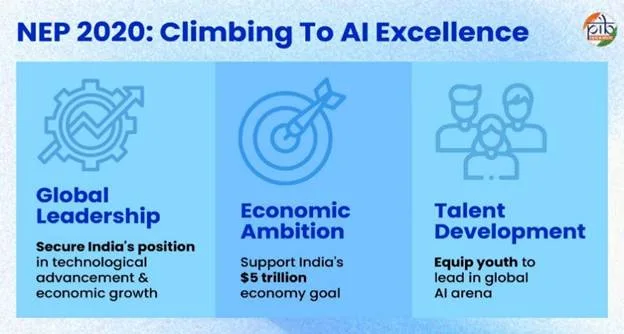
To execute this transition across professional programs, the All India Council for Technical Education (AICTE) redesigned its structural curriculum guidelines. It has formally embedded specialized academic tracks across deep-tech industries, including Artificial Intelligence (AI), Augmented Reality (AR), Virtual Reality (VR), and Data Science, to optimize the digital skill readiness of the modern student workforce (Source: Press Information Bureau).
2. Infrastructure Scale: Capital Allocations and Digital Portals
The execution of smart learning mechanisms is heavily accelerated through massive public tech investments and central repository upgrades:
- The IndiaAI Mission Capital Framework: The Union Cabinet officially approved a financial allocation of ₹10,371.92 crore to scale national computing infrastructure, establish centralized AI datasets, and incentivize advanced AI research frameworks across core consumer sectors, including targeted educational applications (Source: Press Information Bureau).
- The DIKSHA Portal Scale: The Digital Infrastructure for Knowledge Sharing (DIKSHA) under the PM e-Vidya initiative has expanded to support over 2 crore registered users. The platform acts as the core national delivery system, provisioning over 3.17 lakh distinct e-content items and 6,600 digital textbooks across 36 languages to institutionalize equal educational equity across standard boards (Source: Press Information Bureau).
- CIET-NCERT Virtual Labs Implementation: In direct alignment with national mandates, the Central Institute of Educational Technology (CIET-NCERT) officially launched virtual laboratory integrations directly into the DIKSHA system. This integration allows students to run scientific simulations and digital test cases directly on standard portals rather than relying solely on text observation modules (Source: Central Institute of Educational Technology).
3. Advanced Integration: Embedded AI for Classroom Personalization
The ongoing expansion of centralized portals focuses on implementing adaptive AI to customize the pacing and accessibility of standard study material:
- Adaptive Voice and Search Automation: Ongoing upgrades across the national educational repositories integrate specialized machine learning filters, such as voice-activated reading features for visually challenged individuals and automated keyword search matrices within large instructional video data banks (Source: Press Information Bureau).
- Comprehensive Faculty Retraining: National agencies are systematically establishing structured training frameworks - such as the National Training Modules on Leveraging AI for School Education - to build tech literacy across thousands of institutional educators, preparing them to integrate interactive 3D simulations directly into everyday curricula (Source: Central Institute of Educational Technology).
Aligning Institutional Delivery with Vidya XR
The central government policies and infrastructural pipelines have firmly established that 3D assets and intelligent personalized loops optimize concept retention. However, for most schools and colleges, the final roadblock to implementing these mandates is the operational cost of managing standalone, fragile VR headsets.
This is exactly where Vidya XR resolves the execution gap. Engineered in complete alignment with the NEP 2020 directives, Vidya XR delivers browser-based WebXR technology.
Why Vidya XR Fits the Government Vision:
- Zero Hardware Constraints: Institutions do not need to purchase expensive, specialized hardware arrays. Vidya XR optimizes high-fidelity 3D science labs, complex spatial geometry modules, and technical training environments to run natively inside any standard web browser.
- Instant Scalability: By utilizing the smartphones, laptops, and tablets already present in classrooms or homes, it matches the government's objective of high-speed, high-scale, and highly cost-effective digital delivery.
- True Experiential Progress: Moving far beyond passive video streaming channels, it empowers students to rotate, test, and dissect simulated scientific processes, bridging the exact practical exposure gap highlighted by the Ministry of Education.
The structural mandates are clear, the budgets are allocated, and the infrastructure is ready. True modern education has evolved beyond flat video consumption into browser-accessible spatial learning.
For a closer look at this, see our guides to AI Tutors for Indian Students and Digital Learning in Rural India.
For a closer look at this, see our guide to The Future of VR Education in India.