Why Every Educational Platform Will Need a 3D Learning Layer by 2030
Why Every Educational Platform Will Need a 3D Learning Layer by 2030
Education is evolving rapidly.
For decades, digital learning mainly focused on videos, PDFs, quizzes, and online classes. While these tools improved accessibility, they still relied heavily on passive learning.
But students today consume information differently.
They interact with short-form content, visual media, simulations, gaming environments, and immersive experiences every day. Traditional content formats are struggling to keep pace with these changing learning behaviors.
This is why a new concept is emerging across the education industry:
The 3D Learning Layer
The future of education may not replace existing learning systems - it will enhance them through interactive 3D experiences integrated directly into learning platforms.
By 2030, educational platforms that fail to provide immersive and experiential learning may face significant challenges in student engagement, retention, and learning outcomes. Research and industry trends increasingly point toward immersive technologies becoming a core part of modern education.
What Is a 3D Learning Layer?
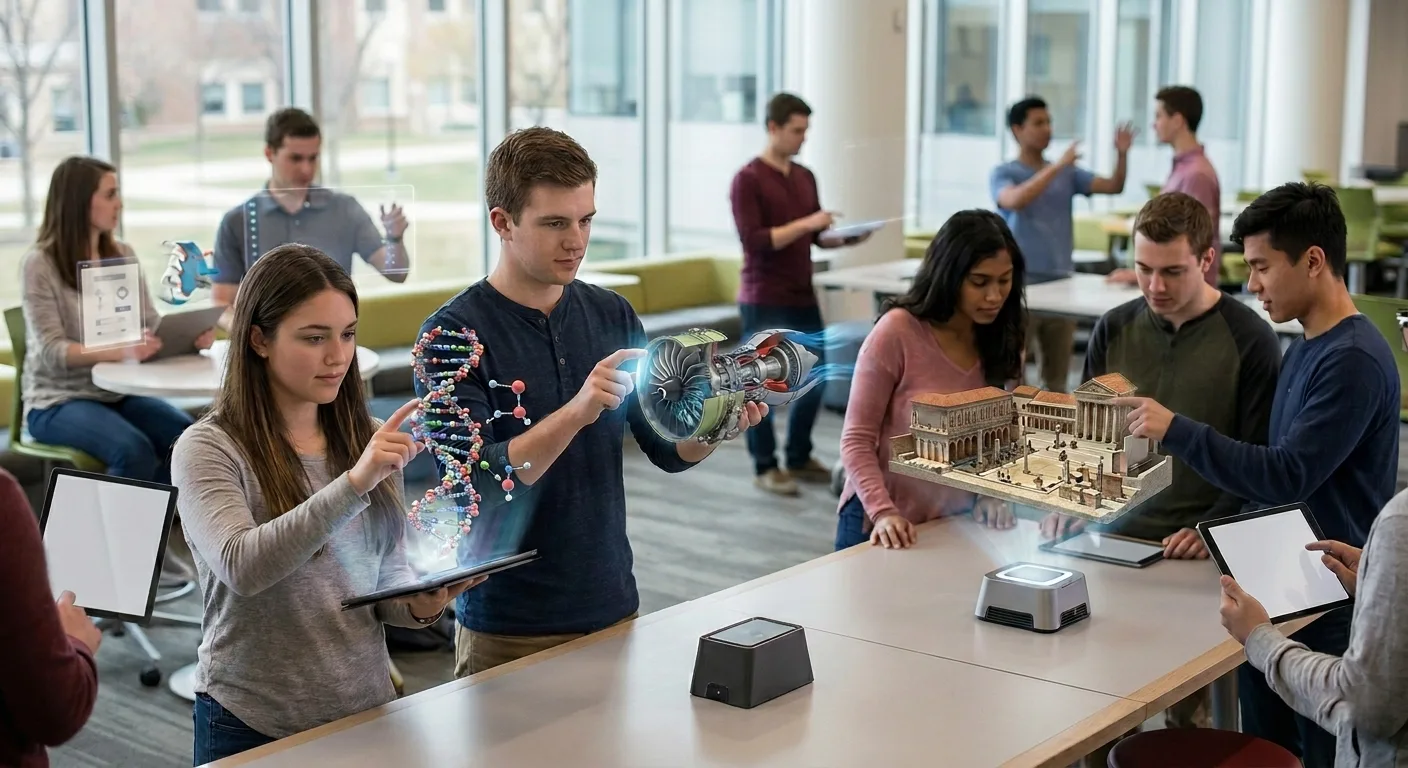
A 3D Learning Layer is an immersive visual layer added on top of traditional educational content.
Instead of only reading or watching, students can:
- Explore 3D models
- Interact with simulations
- Conduct virtual experiments
- Visualize complex concepts
- Learn through experience
Think of it as adding interactivity and spatial understanding to existing education systems.
The goal is not to replace teachers.
The goal is to improve how students understand information.
Why Traditional Content Has Reached Its Limit

Most online learning platforms still depend on:
- Recorded lectures
- PDFs
- Presentations
- Static diagrams
- Text-heavy lessons
These methods deliver information but often struggle to create deep understanding.
Students frequently face challenges when learning topics that require visualization, including:
- Human anatomy
- Physics
- Engineering
- Chemistry
- Architecture
- Astronomy
Reading about a concept and experiencing a concept are very different learning processes.
Educational researchers increasingly emphasize experiential and immersive approaches because they improve engagement and understanding.
The Shift From Content Consumption to Experience Consumption
One of the biggest changes happening in education is how students prefer to learn.
Modern learners are moving from:
Watching → Experiencing
Instead of seeing a diagram of the solar system, students want to explore it.
Instead of reading about the human heart, students want to interact with it.
Instead of memorizing formulas, students want to understand how concepts behave in real-world simulations.
This trend aligns closely with broader immersive learning developments across education and workforce training sectors.
Why 3D Learning Improves Understanding
The human brain processes visual information significantly faster than text.
When students can interact with educational content spatially, they often gain:
- Better conceptual clarity
- Faster comprehension
- Improved memory retention
- Higher engagement levels
- Greater curiosity
This is especially useful for subjects involving movement, structure, systems, or real-world processes.
Interactive learning transforms abstract concepts into understandable experiences.
The Rise of Browser-Based 3D Learning
One major reason immersive education is becoming more practical is the growth of browser-based technologies.
Previously, XR experiences required:
- App downloads
- Large software installations
- Specialized hardware
- Complex setup processes
Today, WebXR and modern browser technologies allow immersive experiences to run directly through web platforms.
This reduces friction and improves accessibility for students. Industry discussions increasingly highlight browser-based immersive learning as a scalable solution for education.
How Educational Platforms Will Evolve by 2030
Most education platforms currently organize content into:
- Courses
- Videos
- Assessments
- Assignments
The next generation of platforms may add:
Interactive 3D Modules
Students explore concepts instead of only reading them.
Virtual Laboratories
Experiments become accessible without expensive physical equipment.
Immersive Simulations
Real-world scenarios can be recreated digitally for safer practice.
Spatial Learning Environments
Students learn through interaction and exploration rather than passive observation.
These developments are already appearing across higher education, training, and enterprise learning environments.
The Growing Importance of Experiential Learning
Educational institutions worldwide are placing greater focus on:
- Practical understanding
- Critical thinking
- Skill development
- Problem-solving
- Real-world application
Experiential learning helps students move beyond memorization.
Instead of asking:
"Can the student remember this?"
Education increasingly asks:
"Can the student apply this?"
Immersive technologies support this transition by allowing students to practice concepts in interactive environments.
Industries Already Using Immersive Learning
The adoption of immersive education is no longer limited to schools.
Industries using XR-based training include:
- Healthcare
- Aviation
- Manufacturing
- Engineering
- Defense
- Corporate learning
Organizations are increasingly investing in immersive training because it improves skill development and reduces learning risks.
Education is expected to follow the same path.
Challenges That Need to Be Solved
Despite its potential, 3D learning still faces challenges.
These include:
- Content creation costs
- Device compatibility
- Internet performance
- Learning design standards
- Accessibility requirements
Researchers also emphasize the importance of balancing innovation with student safety, privacy, and effective instructional design.
As technology improves and development tools become more accessible, these barriers are expected to decrease.
Why Early Adoption Matters
The biggest educational shifts rarely happen overnight.
Schools and learning platforms that adopt immersive technologies early gain advantages such as:
- Higher student engagement
- Better learning experiences
- Stronger differentiation
- Future-ready infrastructure
- Improved educational outcomes
As AI, XR, and Web-based technologies continue to converge, immersive learning is becoming less of an experiment and more of a long-term educational strategy.
For a closer look at this, see our guide to Does VR Improve Learning Retention? What the Research Actually Shows.
Conclusion
The future of education is becoming more interactive, visual, and experience-driven.
Students no longer want to simply consume information - they want to explore it.
A 3D Learning Layer represents the next evolution of digital education, helping learners understand complex concepts through interaction, simulation, and immersion.
By 2030, immersive learning may become as common as video learning is today.
Educational platforms that successfully combine traditional content with interactive 3D experiences will be better positioned to meet the expectations of future learners and create deeper, more meaningful learning experiences.