Combination Reaction: Magnesium
Science · Lab · 3 min · English, Hindi, Gujarati, Marathi
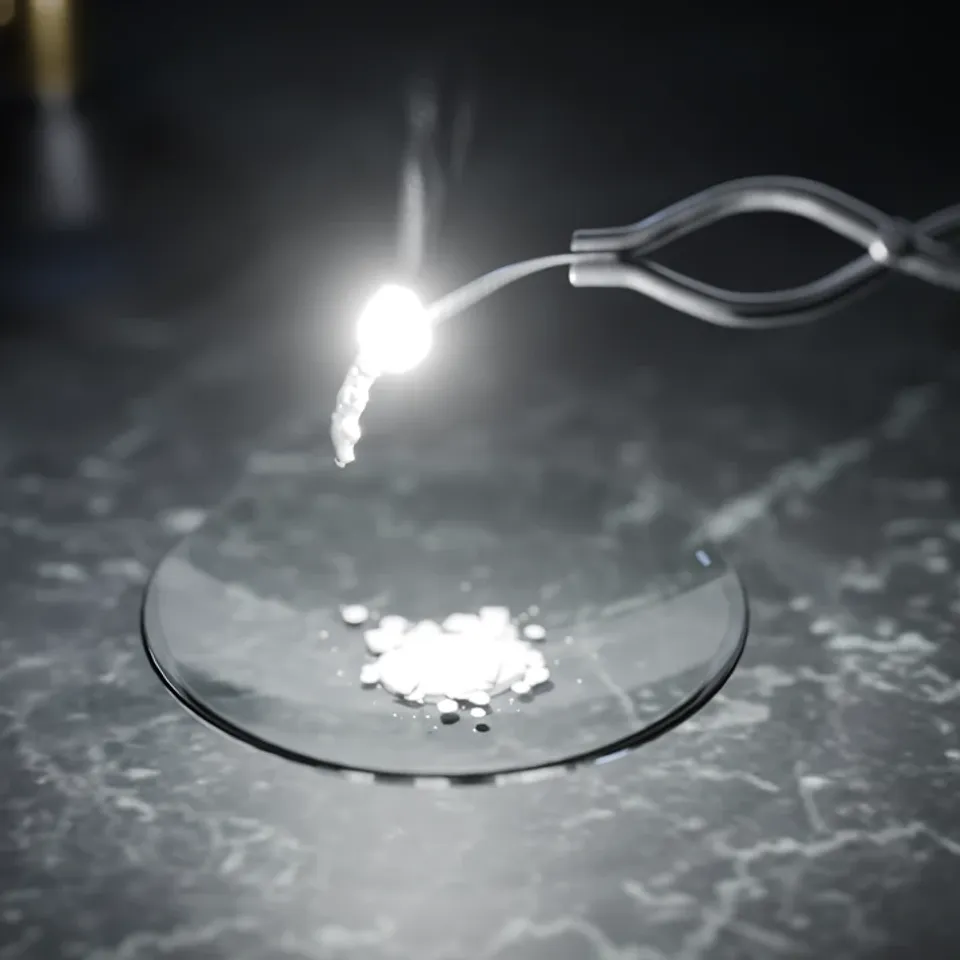
Light a burner and hold a magnesium ribbon in the flame. Watch it burn with a dazzling white light and turn into white magnesium oxide in a combination reaction.
NCERT and CBSE · Class 10 Science · Chapter 1: Chemical Reactions and Equations
What you will learn
- Light a burner and hold a magnesium ribbon in its flame
- Observe magnesium burning with a bright white light
- Identify the white powder formed as magnesium oxide
- Explain why burning magnesium is a combination and exothermic reaction
Key terms
- Magnesium ribbon
- A thin strip of the metal magnesium
- Magnesium oxide
- The white powder formed when magnesium burns in air
- Combination reaction
- Two or more substances combine to form one new product
- Exothermic reaction
- A reaction that gives off heat and light
- Chemical change
- A change that forms a new substance
- Tongs
- A tool for holding hot objects safely
Inside this lab
- 0:03 Getting the ribbon ready A magnesium ribbon is rubbed with sandpaper to remove its dull layer, then held in tongs in a burner flame. It burns very brightly, so it should be kept as far from the eyes as possible.
- 0:31 A dazzling white flame The ribbon burns with a dazzling white flame, giving out heat and light, and leaves a white powder called magnesium oxide. Like a burnt matchstick, it cannot turn back, so a new substance has formed in a chemical change.
- 1:01 Writing a balanced equation Magnesium plus oxygen gives magnesium oxide, but oxygen comes as pairs of atoms, so one is left over at first. Atoms are never made or lost, so the balanced equation is 2Mg + O₂ → 2MgO.
- 1:36 An exothermic combination reaction Magnesium and oxygen combine to form a single product, so this is a combination reaction. It gives out heat and light, so it is also an exothermic reaction.
Read more on the blog
- CBSE Class 10 Chemistry in 3D: Chemical Reactions and the 3D Periodic Table
- 3D Chemistry Experiments for Students: Learn Reactions by Doing
- Burning of Magnesium Ribbon Experiment Class 10: Observation, Equation and Precautions
More chapters
- Chemical Reactions and Equations: Learn to recognise a chemical reaction, write and balance chemical equations, and tell combination, decomposition and displacement reactions apart, with oxidation and reduction.
- Exothermic Reaction: Quicklime: Add quicklime to a beaker and pour water on it. Watch it hiss, steam and crumble into slaked lime as the temperature shoots up, then whitewash a wall with it.
- Human Heart: See how the heart pumps blood around the body: its four chambers, the valves that keep blood flowing one way, and the double circulation through the lungs and the body.
- Transportation in Plants: See how plants move water, minerals and food: roots and root hairs absorb water, xylem carries it up, transpiration pulls it through the plant, and phloem carries food from the leaves.