Force and Laws of Motion
Science · Chapter · 3 min 30 sec · English, Hindi, Gujarati, Marathi
Explore Newton's three laws of motion: why objects stay at rest or keep moving, how force, mass and acceleration are linked, and why every action has an equal and opposite reaction.
NCERT and CBSE · Class 9 Science · Chapter 6: How Forces Affect Motion
What you will learn
- State Newton's three laws of motion
- Explain inertia and how mass affects it
- Relate force, mass and acceleration
- Identify action and reaction pairs
Key terms
- Force
- A push or pull that can change motion
- Inertia
- A body's resistance to a change in motion
- Momentum
- The product of mass and velocity
- Newton's third law
- Every action has an equal, opposite reaction
Inside this chapter
- 0:00 What a force is Pulling a drawer open or pushing it shut uses a force. A force is a push or a pull, and it can start, stop or change the motion of an object.
- 0:24 Balanced and unbalanced forces Two people pushing a stalled car equally from opposite sides cannot move it, because the forces are balanced. If one stops pushing, the force becomes unbalanced and the car starts to roll.
- 0:55 Newton's first law An object stays at rest or keeps moving unless an unbalanced force acts on it. When a car brakes suddenly, the passengers lurch forward because their bodies tend to keep moving.
- 1:23 More mass, more inertia Inertia is how strongly an object resists a change in its motion. A full shopping cart has more mass than an empty one, so it has more inertia and is harder to push.
- 1:48 Newton's second law Force equals mass times acceleration, F = ma, so the same force speeds up a lighter rocket faster. Momentum is mass times velocity, p = mv, and a force is what changes it.
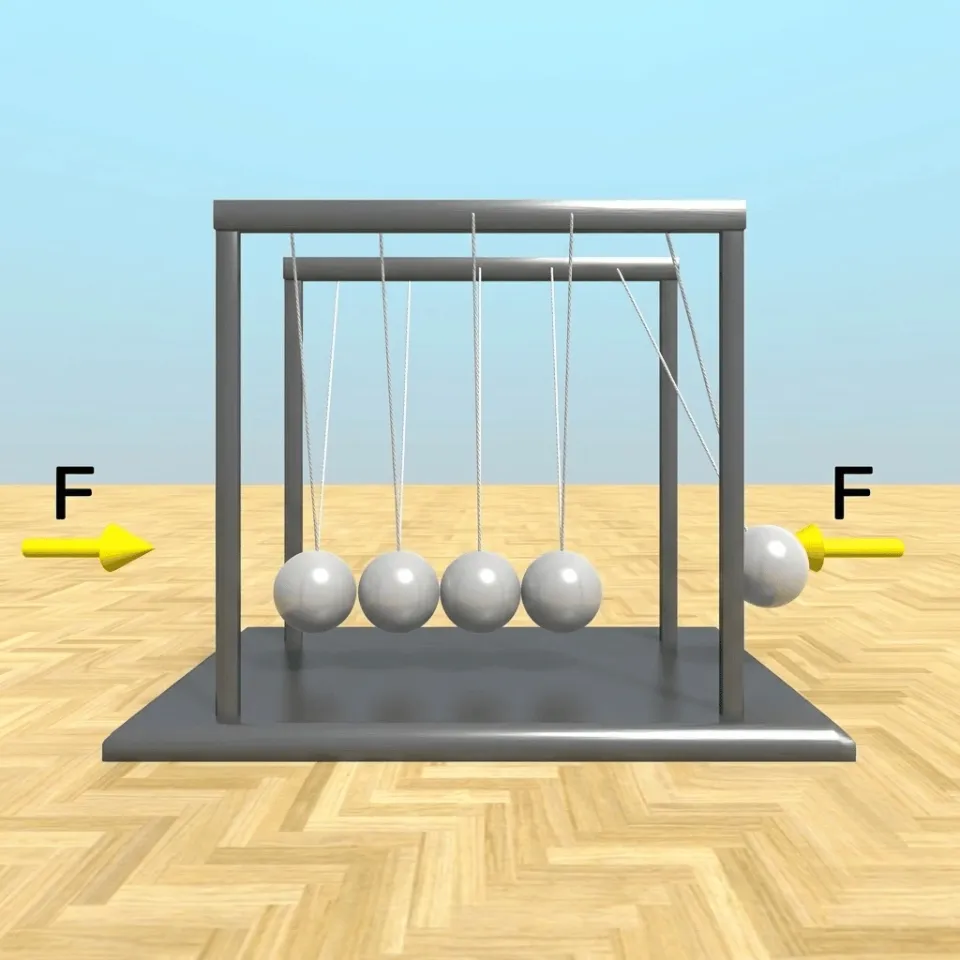
- 2:20 Newton's third law Every action has an equal and opposite reaction. The two forces are the same size, point in opposite directions and act on different objects at the same time.
- 2:49 Feel it when you clap When you clap, your right hand pushes your left hand and your left hand pushes back just as hard. That is why you feel the impact on both hands.
Read more on the blog
More chapters
- Laws of Motion Activity: Push, pull and launch objects in a hands-on simulation that brings Newton's laws of motion to life, and predict how force and mass change acceleration.
- The Fundamental Unit of Life: Look inside the cell, the basic unit of all living things, explore the organelles that keep it working, and compare prokaryotic and eukaryotic, plant and animal cells.
- Onion Peel Experiment: Prepare an onion peel slide step by step and look through a microscope at real plant cells, with their cell wall, cell membrane and nucleus.
- Bone: The Body's Hard Framework: Look into a piece of bone, cut open, and one tiny unit of it, magnified. Open its rings of hard matrix to find the bone cells and the blood vessels in its canal, and see why bone is strong, rigid and supports the body.