The Fundamental Unit of Life
Science · Chapter · 4 min 22 sec · English, Hindi, Gujarati, Marathi
Look inside the cell, the basic unit of all living things, explore the organelles that keep it working, and compare prokaryotic and eukaryotic, plant and animal cells.
NCERT and CBSE · Class 9 Science · Chapter 2, Cell: The Building Block of Life
What you will learn
- Identify the cell as the basic unit of life
- Distinguish prokaryotic from eukaryotic cells
- Describe key organelles and their functions
- Compare plant and animal cells
Key terms
- Cell
- The basic structural and functional unit of life
- Nucleus
- The control centre containing the cell's DNA
- Cell membrane
- The boundary controlling what enters and leaves
- Cytoplasm
- The jelly-like fluid where organelles float
Inside this chapter
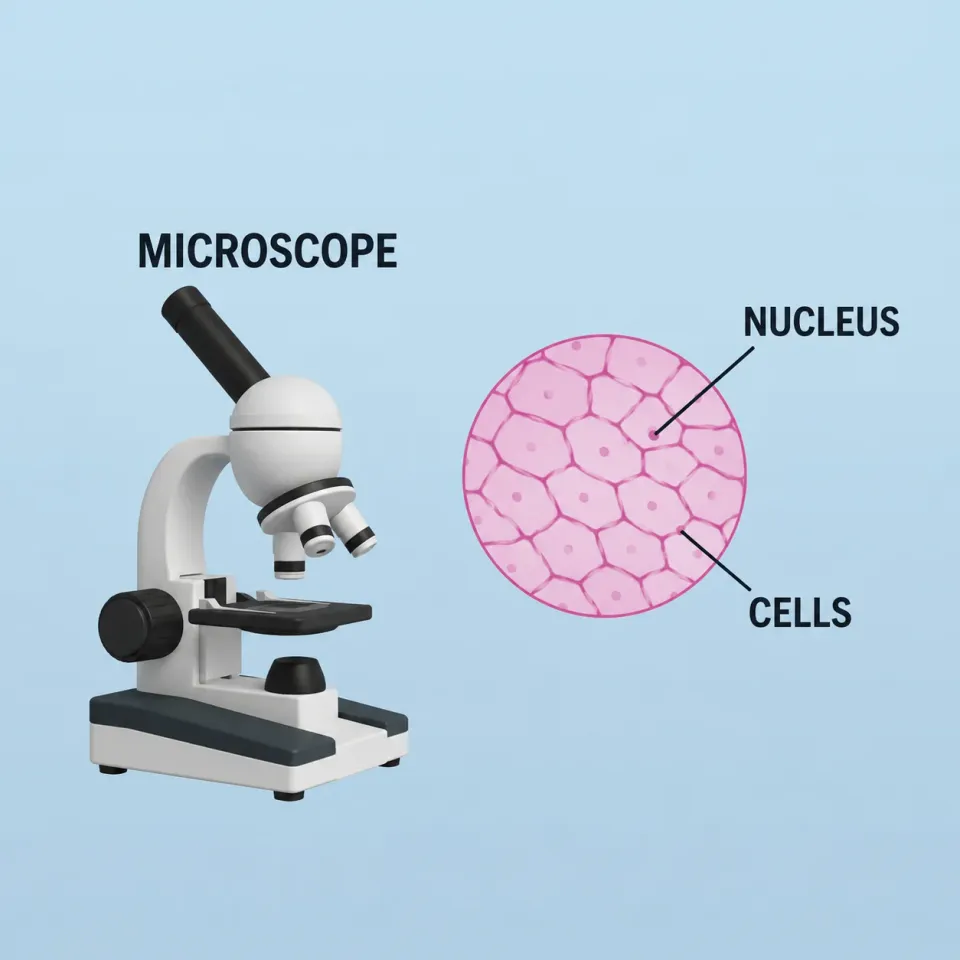
- 0:00 Hooke names the cell In 1665, Robert Hooke looked at a thin slice of cork through a microscope he had designed himself. He saw tiny compartments and named them cells, from the Latin for little rooms.
- 1:06 Diffusion and osmosis Oxygen and carbon dioxide move in and out of cells by diffusion, from high to low concentration. Water moves by osmosis, so a cell may swell, shrink or stay the same depending on the solution around it.
- 1:31 Three main parts of a cell The plasma membrane controls what enters and leaves, the jelly-like cytoplasm holds the organelles, and the nucleus carries the genetic material that controls the cell. Prokaryotic cells such as bacteria have no true nucleus, and their DNA lies in the nucleoid.
- 2:02 Nucleus, DNA and chromosomes Eukaryotic cells, such as plant and animal cells, have a nucleus wrapped in a double membrane. Its chromatin carries DNA and genes, and before the cell divides it coils up into chromosomes.
- 2:41 ER, Golgi and lysosomes Rough ER makes proteins, smooth ER makes fats, and the Golgi apparatus packs cell products into small vesicles. Lysosomes hold enzymes that break down waste and can even digest their own cell, so they are called suicide bags.
- 3:17 Mitochondria, plastids and vacuoles Mitochondria, the powerhouse of the cell, release energy that is stored as ATP. Plant cells also have chloroplasts that make food from sunlight, leucoplasts that store food, and large sap-filled vacuoles that keep the cell firm.
- 3:52 Mitosis and meiosis Cells divide so we can grow, heal wounds and reproduce. Mitosis gives two identical daughter cells, while meiosis gives four cells with half the chromosomes, used in reproduction.
Read more on the blog
More chapters
- Onion Peel Experiment: Prepare an onion peel slide step by step and look through a microscope at real plant cells, with their cell wall, cell membrane and nucleus.
- Bone: The Body's Hard Framework: Look into a piece of bone, cut open, and one tiny unit of it, magnified. Open its rings of hard matrix to find the bone cells and the blood vessels in its canal, and see why bone is strong, rigid and supports the body.
- Epidermis and Stomata: The Leaf's Outer Layer: Open the tiny pores in the outer layer of a leaf and watch gases pass in and out and water vapour escape. Meet the flat, tightly packed cells of the epidermis and its waxy cuticle, then close the stomata again.
- Sclerenchyma: The Hard, Strong Tissue: Lift a long, narrow cell out of a block of plant tissue and see its thick wall of lignin, with hardly any space inside. Put a weight on the tissue: it does not bend. Find where this hard tissue is found, from leaf veins to coconut husk.