Epidermis and Stomata: The Leaf's Outer Layer
Science · Lab · 2 min 30 sec · English, Hindi, Gujarati, Marathi
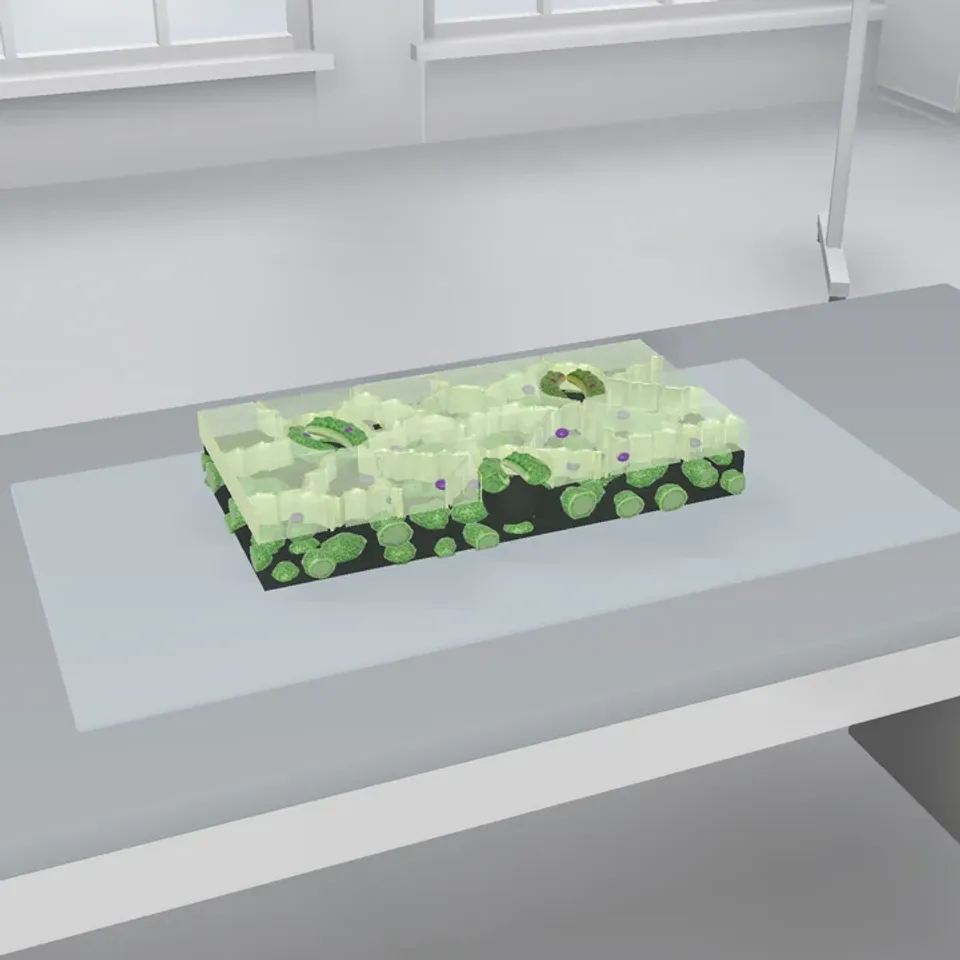
Open the tiny pores in the outer layer of a leaf and watch gases pass in and out and water vapour escape. Meet the flat, tightly packed cells of the epidermis and its waxy cuticle, then close the stomata again.
NCERT and CBSE · Class 9 Science · Chapter 3: Tissues in Action
What you will learn
- Describe the cells of the epidermis
- State how the epidermis and its cuticle protect the plant
- Identify the stomata and the guard cells around them
- Explain gaseous exchange and transpiration through the stomata
Key terms
- Epidermis
- The outermost layer of the plant body, a single layer of flat, tightly packed cells
- Cuticle
- A waxy layer of cutin that covers the epidermis
- Stomata
- Tiny pores in the epidermis of leaves
- Guard cells
- The two cells around each pore, which open and close it
- Gaseous exchange
- Gases passing in and out of the leaf through the stomata
- Transpiration
- The loss of water as water vapour through the stomata
Inside this lab
- 0:03 Tiny pores called stomata Magnified 400 times, the outer layer of a leaf shows tiny openings called stomata. Each one has two guard cells, and when they swell, the opening widens.
- 0:22 The epidermis and cuticle The epidermis is a single layer of flat, tightly packed cells on the outside of the plant, protecting every part of it. A waxy layer on top, the cuticle, guards against injury and parasites.
- 0:47 Gas exchange and transpiration Plants in very dry places have a thick cuticle, so they lose less water. Gases pass in and out through the stomata, and water escapes as vapour in transpiration, which helps pull water up through the xylem.
- 1:19 Closing the pores When the guard cells shrink, the pore closes. Then less water vapour can escape from the leaf.
Read more on the blog
More chapters
- Bone: The Body's Hard Framework: Look into a piece of bone, cut open, and one tiny unit of it, magnified. Open its rings of hard matrix to find the bone cells and the blood vessels in its canal, and see why bone is strong, rigid and supports the body.
- Sclerenchyma: The Hard, Strong Tissue: Lift a long, narrow cell out of a block of plant tissue and see its thick wall of lignin, with hardly any space inside. Put a weight on the tissue: it does not bend. Find where this hard tissue is found, from leaf veins to coconut husk.
- Meristematic Tissue: How Plants Grow: Tap a growing plant to find where it grows: its shoot and root tips grow longer, its stem grows thicker, and a cut stem grows back. Then look at the dividing meristem cells up close.
- Epithelial Tissue: The Body's Covering: Watch worn-out cells flake off the many-layered skin and tiny cilia move. Explore five kinds of epithelial tissue and see how the shape of their closely packed cells suits each job: exchange, protection, making substances, sensing and absorbing.