Meristematic Tissue: How Plants Grow
Science · Lab · 3 min 20 sec · English, Hindi, Gujarati, Marathi
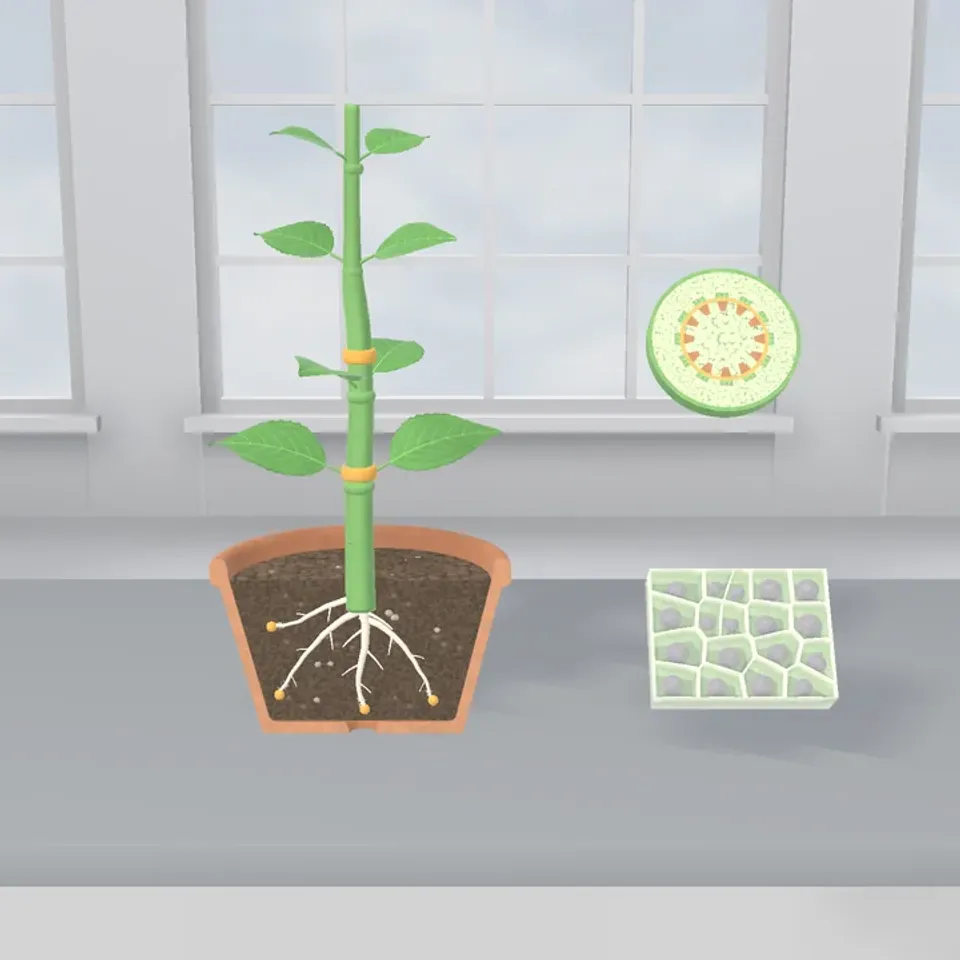
Tap a growing plant to find where it grows: its shoot and root tips grow longer, its stem grows thicker, and a cut stem grows back. Then look at the dividing meristem cells up close.
NCERT and CBSE · Class 9 Science · Chapter 3: Tissues in Action
What you will learn
- Find where meristematic tissue is in a plant
- Name the apical, lateral and intercalary meristems and what each does
- Describe the cells of meristematic tissue
- Explain how new cells become permanent tissue
Key terms
- Meristematic tissue
- A tissue of cells that keep dividing, found only in some places of a plant
- Apical meristem
- Meristem at the tips of the shoot and the root; growth in length
- Lateral meristem
- A ring of dividing cells along the stem; growth in girth
- Intercalary meristem
- Meristem at the base of the internode; regrowth after cutting
- Node
- The point on a stem where leaves arise
- Differentiation
- New cells changing to do one job and becoming permanent tissue
Inside this lab
- 0:03 Growth at the tips Plants grow only in certain places. At the tip of the shoot, cells keep dividing, so the shoot grows longer.
- 0:18 Apical meristem Root tips have such cells too, so roots grow deeper. A tissue of dividing cells is meristematic tissue, and at the tips it is the apical meristem, which makes the plant longer.
- 0:41 Lateral meristem A slice across a stem shows a ring of dividing cells, the lateral meristem. It adds new cells on both sides of the ring, so the stem grows thicker, or in girth.
- 1:07 Intercalary meristem Dividing cells at the base of the internode, the part between two nodes, form the intercalary meristem. It lets a stem grow after its tip is cut, so grass grows back after mowing.
- 1:33 What meristem cells look like Meristematic cells are small, with thin walls, a large, prominent nucleus and dense cytoplasm. They have no vacuoles and are packed tightly, with almost no space between them.
- 2:07 Becoming permanent tissue Some new cells keep dividing. Others stop, take on one job such as support, transport or storage, and become permanent tissue. This change is called differentiation.
Read more on the blog
More chapters
- Bone: The Body's Hard Framework: Look into a piece of bone, cut open, and one tiny unit of it, magnified. Open its rings of hard matrix to find the bone cells and the blood vessels in its canal, and see why bone is strong, rigid and supports the body.
- Epidermis and Stomata: The Leaf's Outer Layer: Open the tiny pores in the outer layer of a leaf and watch gases pass in and out and water vapour escape. Meet the flat, tightly packed cells of the epidermis and its waxy cuticle, then close the stomata again.
- Sclerenchyma: The Hard, Strong Tissue: Lift a long, narrow cell out of a block of plant tissue and see its thick wall of lignin, with hardly any space inside. Put a weight on the tissue: it does not bend. Find where this hard tissue is found, from leaf veins to coconut husk.
- Epithelial Tissue: The Body's Covering: Watch worn-out cells flake off the many-layered skin and tiny cilia move. Explore five kinds of epithelial tissue and see how the shape of their closely packed cells suits each job: exchange, protection, making substances, sensing and absorbing.