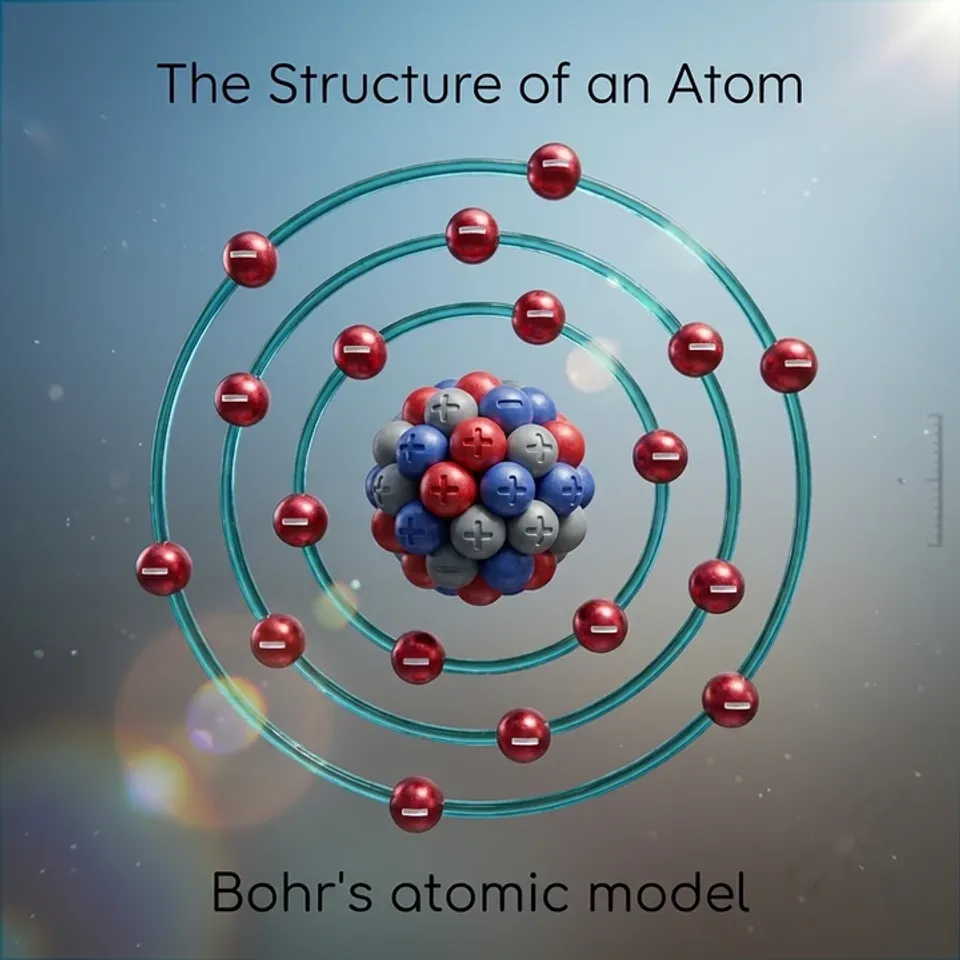
Structure of the Atom
Science · Chapter · 4 min 4 sec · English, Hindi, Gujarati, Marathi
Journey inside the atom to meet the protons, neutrons and electrons that make up everything around you, and learn atomic number, mass number and how electrons fill shells.
NCERT and CBSE · Class 9 Science · Chapter 8: Journey Inside the Atom
What you will learn
- Describe the structure of an atom and its particles
- Understand atomic number and mass number
- Explain how electrons are arranged in shells
- Relate atomic structure to the periodic table
Key terms
- Atom
- The smallest particle of an element
- Proton
- A positively charged particle in the nucleus
- Electron
- A negatively charged particle around the nucleus
- Atomic number
- The number of protons in an atom
Inside this chapter
- 0:00 Particles inside the atom Atoms are not indivisible. Experiments by J.J. Thomson, Goldstein and Chadwick found electrons, protons and neutrons.
- 0:36 Models of the atom Thomson pictured a positive sphere with electrons in it, like seeds in a watermelon. Rutherford showed a dense positive nucleus, and Bohr put electrons in fixed energy levels.
- 1:16 How electrons fill shells Shells fill in order, and a shell can hold at most 2n² electrons: 2 in the first, 8 in the second and 18 in the third.
- 2:06 Valency Atoms are most stable with a full outer shell. Sodium gives away its one outer electron and chlorine gains one. This combining capacity is called valency.
- 2:35 Atomic number and mass number The atomic number is the number of protons. The mass number is protons plus neutrons, so carbon-14 has 6 protons and 8 neutrons.
- 3:19 Isotopes Atoms of one element can have different numbers of neutrons, like protium, deuterium and tritium. Cobalt-60 is used to treat cancer and carbon-14 to date ancient remains.
Read more on the blog
- Journey Inside the Atom Class 9: NCERT Chapter 8 Explained in 3D
- Atomic Foundations of Matter Class 9 in 3D: NCERT Chapter 9 Guide
- Structure of the Atom and the 3D Periodic Table: Interactive Visual Learning for CBSE Students
More chapters
- Rutherford's Model of an Atom: Watch Rutherford's α-particle scattering experiment: alpha particles fired at thin gold foil show that an atom is mostly empty space, with a tiny, heavy, positively charged nucleus at its centre.
- The Fundamental Unit of Life: Look inside the cell, the basic unit of all living things, explore the organelles that keep it working, and compare prokaryotic and eukaryotic, plant and animal cells.
- Onion Peel Experiment: Prepare an onion peel slide step by step and look through a microscope at real plant cells, with their cell wall, cell membrane and nucleus.
- Bone: The Body's Hard Framework: Look into a piece of bone, cut open, and one tiny unit of it, magnified. Open its rings of hard matrix to find the bone cells and the blood vessels in its canal, and see why bone is strong, rigid and supports the body.