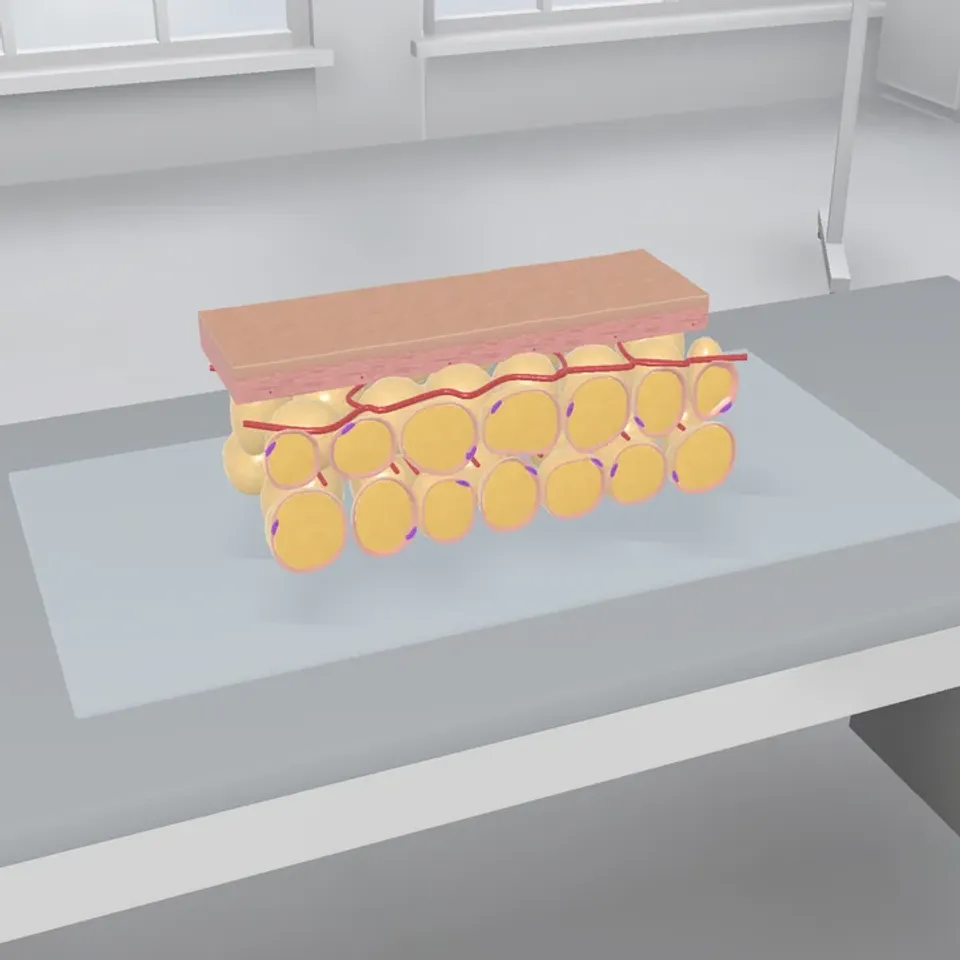
Adipose Tissue: The Body's Fat Store
Science · Lab · 2 min 15 sec · English, Hindi, Gujarati, Marathi
Look into the tissue just below your skin. Its cells are filled with fat globules. Use some of the fat for energy and watch the globules shrink, store it again, and find out how the fat below the skin keeps the body warm.
NCERT and CBSE · Class 9 Science · Chapter 3: Tissues in Action
What you will learn
- Describe the cells of adipose tissue
- Explain that adipose tissue stores fat
- Describe how stored fat is used and stored again
- State where adipose tissue is found and why it is an insulator
Key terms
- Adipose tissue
- A connective tissue that stores fat
- Fat cell
- A cell of adipose tissue, filled by one big drop of fat
- Fat globule
- The big drop of stored fat inside a fat cell
- Nucleus
- Pushed to one side of the fat cell by the fat globule
- Insulator
- Something that keeps heat in; the fat below the skin keeps body heat in
Inside this lab
- 0:03 Cells full of fat Just below the skin, magnified 200 times, are cells packed with something yellow. Each fat cell holds one large fat globule that pushes the nucleus to the side, leaving only a thin rim of cytoplasm.
- 0:31 Fat for energy Tissue that stores fat this way is adipose tissue, a kind of connective tissue. When you run or play hard, the stored fat is used for energy, the globules shrink and tiny blood vessels carry the fat away.
- 0:59 Storing extra food When we eat more food than the body needs, the extra is stored as fat. Blood carries it to the fat cells, and the globules fill up again.
- 1:12 A warm layer The layer of fat under the skin keeps body heat in, so adipose tissue works as an insulator. It is also found between the organs inside the body.
Read more on the blog
More chapters
- Bone: The Body's Hard Framework: Look into a piece of bone, cut open, and one tiny unit of it, magnified. Open its rings of hard matrix to find the bone cells and the blood vessels in its canal, and see why bone is strong, rigid and supports the body.
- Epidermis and Stomata: The Leaf's Outer Layer: Open the tiny pores in the outer layer of a leaf and watch gases pass in and out and water vapour escape. Meet the flat, tightly packed cells of the epidermis and its waxy cuticle, then close the stomata again.
- Sclerenchyma: The Hard, Strong Tissue: Lift a long, narrow cell out of a block of plant tissue and see its thick wall of lignin, with hardly any space inside. Put a weight on the tissue: it does not bend. Find where this hard tissue is found, from leaf veins to coconut husk.
- Meristematic Tissue: How Plants Grow: Tap a growing plant to find where it grows: its shoot and root tips grow longer, its stem grows thicker, and a cut stem grows back. Then look at the dividing meristem cells up close.