Electricity
Science · Chapter · 4 min 37 sec · English, Hindi, Gujarati, Marathi
Learn how electric current flows in a circuit, how potential difference and resistance are linked by Ohm's law, and how resistors combine in series and in parallel.
NCERT and CBSE · Class 10 Science · Chapter 11: Electricity
What you will learn
- Define current, potential difference and resistance
- Apply Ohm's law to simple circuits
- Find resistance in series and parallel
- Understand the heating effect of current
Key terms
- Electric current
- Flow of charge, measured in amperes
- Potential difference
- Work to move charge, measured in volts
- Resistance
- Opposition to current, measured in ohms
- Ohm's law
- Voltage equals current times resistance
Inside this chapter
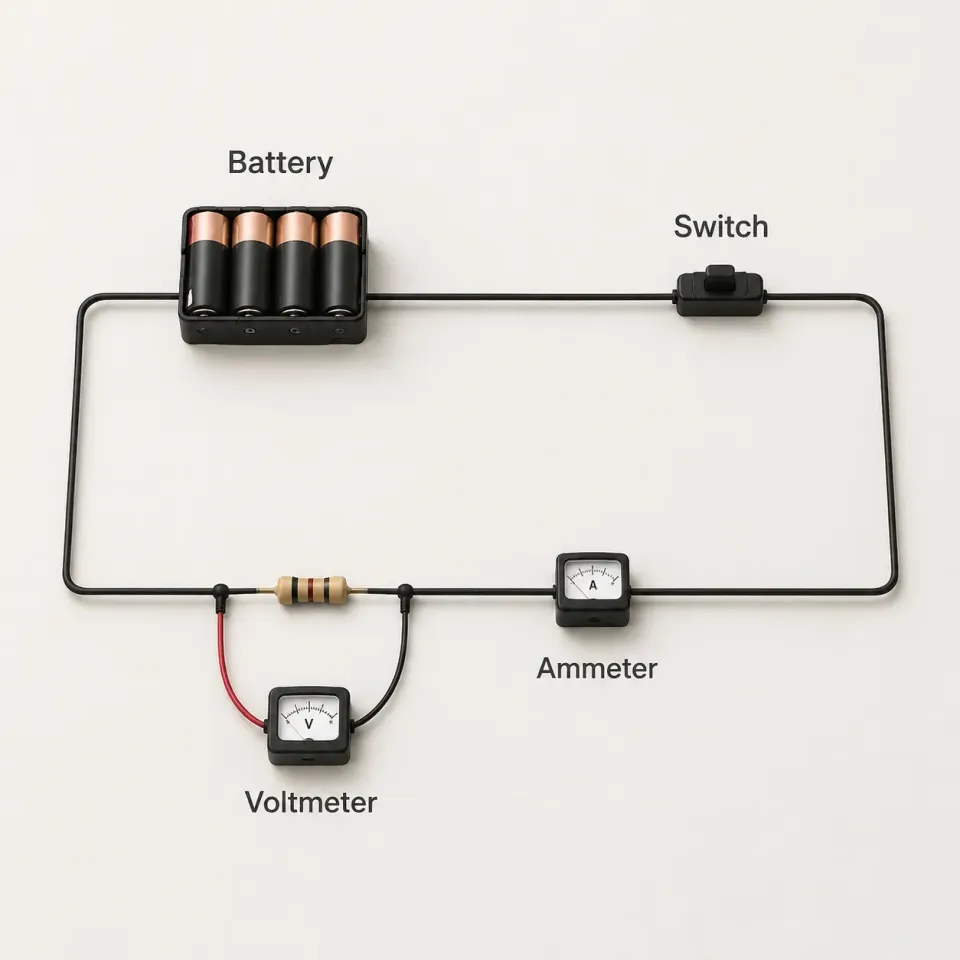
- 0:32 Current is moving charge A battery pushes charges through the wire, and the bulb lights only when the circuit is complete. More charge in less time means a bigger current: I = Q/t.
- 1:03 Potential difference Charges move because of a potential difference, just as a ball rolls down a slide because of gravity. A battery provides this push, a voltmeter measures it, and V = W/Q, the work done divided by the charge.
- 1:31 Circuit diagrams Circuits are drawn with simple symbols instead of pictures of real wires and devices. Like a map, such a diagram makes it easy to see how current flows.
- 1:50 Ohm's law and resistance At constant temperature, current is directly proportional to voltage, so V = IR. Resistance opposes current: it is higher in longer wires, lower in thicker ones and depends on the material, so R = ρl/A (ρ is resistivity).
- 2:25 Series and parallel In series, the same current flows through each resistor and the resistances add up. In parallel, the current splits, the voltage stays the same and the total resistance falls, because the reciprocals of the resistances add.
- 2:59 Heating effect of current Current through a resistor produces heat, which is why chargers, irons and toasters get warm. By Joule's law, H = I²Rt; this heat is useful in heaters but can be dangerous, so we use fuses.
- 3:44 Power and energy Power is how fast electrical energy is used, and P = VI. Energy is power multiplied by time, and electricity bills charge for it in kilowatt hours.
Read more on the blog
- Ohm's Law Class 10: Definition, Formula, V-I Graph and Experiment
- Series and Parallel Circuits Class 10: Formulas, Differences and Numericals
- CBSE Class 10 Physics Practicals in 3D: Ray Optics, Electricity, and Magnetic Effects
More chapters
- Electricity Activity: Build your own circuits and watch how the current changes as you add components, change the voltage and connect resistors in series or in parallel.
- Chemical Reactions and Equations: Learn to recognise a chemical reaction, write and balance chemical equations, and tell combination, decomposition and displacement reactions apart, with oxidation and reduction.
- Combination Reaction: Magnesium: Light a burner and hold a magnesium ribbon in the flame. Watch it burn with a dazzling white light and turn into white magnesium oxide in a combination reaction.
- Exothermic Reaction: Quicklime: Add quicklime to a beaker and pour water on it. Watch it hiss, steam and crumble into slaked lime as the temperature shoots up, then whitewash a wall with it.