Gravitation
Science · Chapter · 3 min 26 sec · English, Hindi, Gujarati, Marathi
Discover the force that pulls every object towards every other: Newton's universal law of gravitation, mass and weight, free fall, and why planets stay in their orbits.
What you will learn
- State Newton's universal law of gravitation
- Explain the difference between mass and weight
- Understand free fall and acceleration due to gravity
- Relate gravitation to planetary motion and tides
Key terms
- Gravitation
- The force of attraction between any two masses
- Mass
- The amount of matter in an object
- Weight
- The force of gravity on an object's mass
- g
- Acceleration due to gravity, about 9.8 m/s squared
Inside this chapter
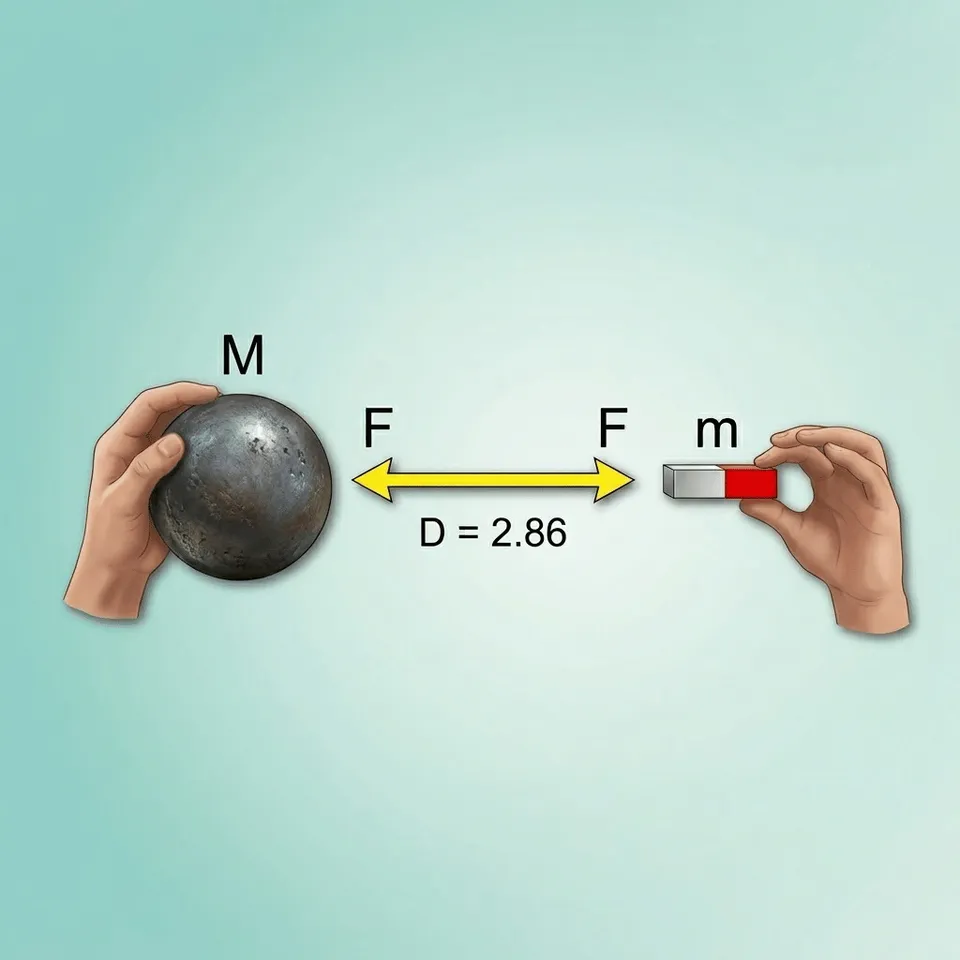
- 0:00 Every object attracts every other Newton found that the force that makes an apple fall also holds the universe together. Every object attracts every other object with this gravitational force.
- 0:30 The law in a formula The pull depends on the two masses and the distance between them: F = G × m1 × m2 / d². It keeps us on Earth, keeps the Moon and planets in orbit and causes ocean tides.
- 0:58 Free fall and g An object falling only because of gravity is in free fall, and its velocity keeps increasing. This acceleration due to gravity is g = GM/R², about 9.8 m/s² on Earth.
- 1:27 Weight on Earth and the Moon Weight is the force of gravity on an object: W = m × g. Mass stays the same everywhere, but the Moon's gravity is weaker, so there you weigh about one sixth as much.
- 1:55 Thrust and pressure Thrust is a force acting at right angles to a surface. Pressure = thrust / area, so the same thrust on a smaller area gives more pressure.
- 2:15 Pressure in fluids and upthrust Liquids and gases press on the base and walls of a container, and pressure on an enclosed fluid spreads equally in all directions. They also push objects up with a force called upthrust.
- 2:51 Floating, sinking and Archimedes Density is mass per unit volume. An object less dense than the fluid floats and a denser one sinks. By Archimedes' principle, upthrust equals the weight of fluid displaced.
Read more on the blog
More chapters
- The Fundamental Unit of Life: Look inside the cell, the basic unit of all living things, explore the organelles that keep it working, and compare prokaryotic and eukaryotic, plant and animal cells.
- Onion Peel Experiment: Prepare an onion peel slide step by step and look through a microscope at real plant cells, with their cell wall, cell membrane and nucleus.
- Bone: The Body's Hard Framework: Look into a piece of bone, cut open, and one tiny unit of it, magnified. Open its rings of hard matrix to find the bone cells and the blood vessels in its canal, and see why bone is strong, rigid and supports the body.
- Epidermis and Stomata: The Leaf's Outer Layer: Open the tiny pores in the outer layer of a leaf and watch gases pass in and out and water vapour escape. Meet the flat, tightly packed cells of the epidermis and its waxy cuticle, then close the stomata again.