Heredity
Science · Chapter · 2 min 42 sec · English, Hindi, Gujarati, Marathi
Learn how traits pass from parents to offspring, what makes a trait dominant or recessive, and what Mendel's experiments with pea plants reveal about genes.
NCERT and CBSE · Class 10 Science · Chapter 8: Heredity
What you will learn
- Explain how traits pass from parents to offspring
- Understand dominant and recessive traits
- Interpret Mendel's experiments with pea plants
- Relate genes and chromosomes to inheritance
Key terms
- Heredity
- Passing of traits from parents to offspring
- Gene
- A unit of inheritance that carries a trait
- Dominant trait
- A trait that shows even with one copy
- Allele
- One of the alternative forms of a gene
Inside this chapter
- 0:00 Alike, yet unique Each generation inherits a basic body design from its parents, yet every individual is different. A dividing bacterium gives nearly identical offspring, but sexual reproduction mixes genetic material from two parents and creates far more variety.
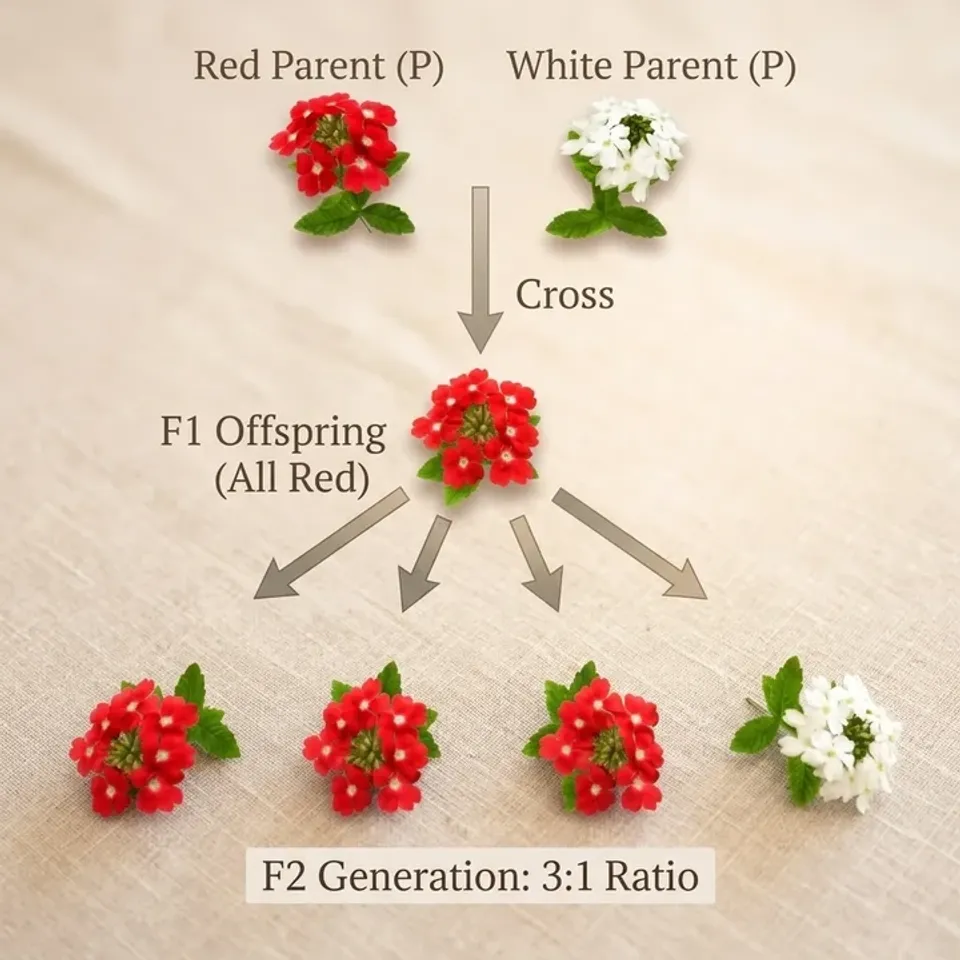
- 0:30 Mendel's tall and short peas Mendel crossed tall pea plants with short ones, and the F1 generation was all tall. When the F1 plants self-pollinated, about one quarter of the F2 plants were short, so the short trait had only been hidden.
- 1:03 Dominant and recessive traits Mendel explained this with two copies of each gene. Tallness is dominant, so one T is enough and both TT and Tt plants are tall; shortness is recessive, so only tt plants are short.
- 1:24 How genes shape traits Genes are pieces of DNA that carry the code for proteins, such as an enzyme that makes a growth hormone. If that enzyme works well, the plant grows tall; if it does not, the plant stays short.
- 1:53 Chromosomes and the child's sex Body cells have two sets of chromosomes, one from each parent, while eggs and sperm get one set, so the full set returns when they join. In humans, females are XX and males XY: every egg carries an X and each sperm an X or a Y, so the father decides the child's sex.
Read more on the blog
More chapters
- Heredity Activity: Mix and match traits in simple crosses to see how characteristics pass from parents to offspring, and predict what the next generation might look like.
- Chemical Reactions and Equations: Learn to recognise a chemical reaction, write and balance chemical equations, and tell combination, decomposition and displacement reactions apart, with oxidation and reduction.
- Combination Reaction: Magnesium: Light a burner and hold a magnesium ribbon in the flame. Watch it burn with a dazzling white light and turn into white magnesium oxide in a combination reaction.
- Exothermic Reaction: Quicklime: Add quicklime to a beaker and pour water on it. Watch it hiss, steam and crumble into slaked lime as the temperature shoots up, then whitewash a wall with it.