Is Matter Around Us Pure?
Science · Chapter · 3 min 51 sec · English, Hindi, Gujarati, Marathi
Learn the difference between pure substances and mixtures, homogeneous and heterogeneous mixtures, and elements and compounds, and the physical methods used to separate mixtures.
NCERT and CBSE · Class 9 Science · Chapter 5: Exploring Mixtures and their Separation
What you will learn
- Distinguish pure substances from mixtures
- Classify mixtures as homogeneous or heterogeneous
- Separate mixtures using physical methods
- Differentiate elements and compounds
Key terms
- Mixture
- Two or more substances not chemically joined
- Solution
- A homogeneous mixture of solute and solvent
- Element
- A pure substance made of one kind of atom
- Compound
- A substance formed by chemically combining elements
Inside this chapter
- 0:00 What pure means in science To a scientist, a substance is pure only if all its particles are chemically the same. By that test, milk, a blend of water, fats and proteins, is a mixture, and so are most things around us.
- 0:32 Homogeneous and heterogeneous In a homogeneous mixture, like sugar dissolved in water, you cannot tell the parts apart. In a heterogeneous mixture, like sand in water or oil floating on water, you can see the different parts.
- 1:08 Solutions, suspensions and colloids Salt water is a solution: clear, stable and uniform. Chalk in water is a cloudy suspension that settles, while milk, fog and smoke are colloids that only look uniform and scatter light, which is called the Tyndall effect.
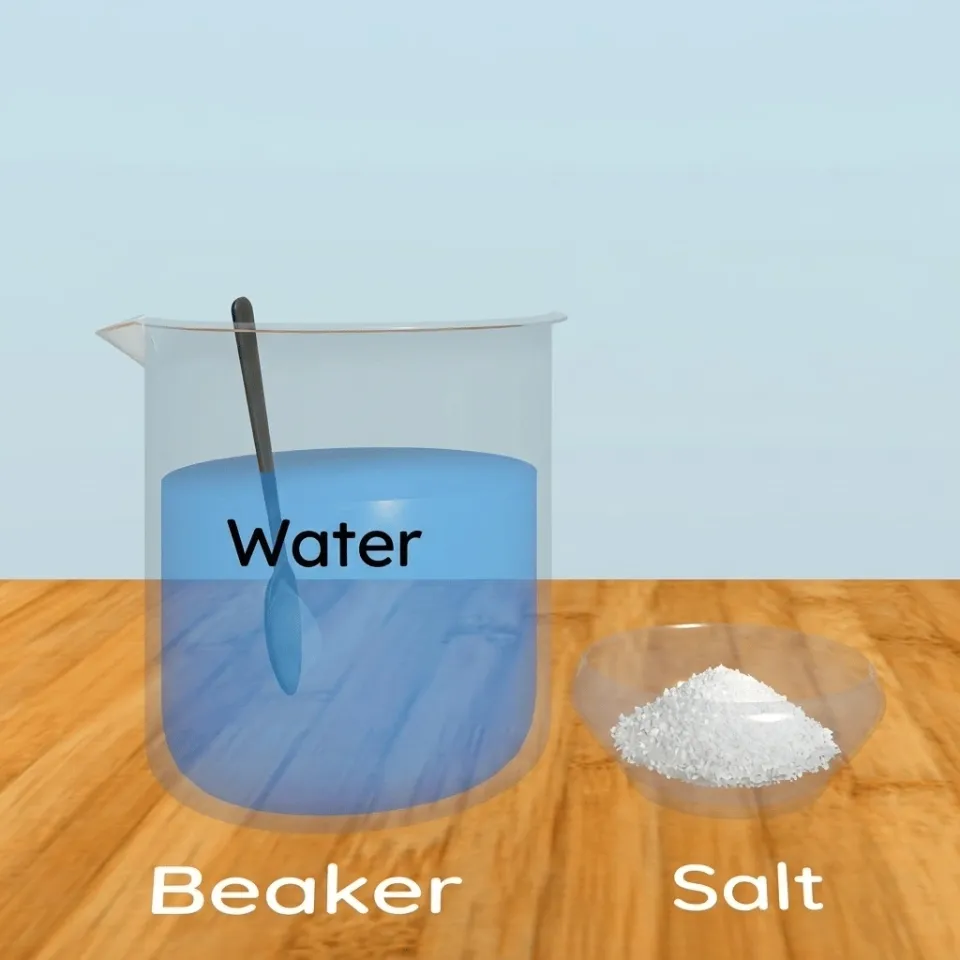
- 1:42 Saturated and unsaturated solutions When no more salt will dissolve, the solution is saturated; if more can still dissolve, it is unsaturated. Heating the solution lets it dissolve more, so temperature affects solubility.
- 1:59 Physical and chemical changes Melting ice and boiling water are physical changes, because the substance stays the same. Burning paper is a chemical change, because it makes something new.
- 2:17 Elements, compounds and mixtures An element has only one type of atom, like gold or oxygen, and a compound such as water, H₂O, forms when elements join chemically. A mixture is only blended, so it can be separated by physical methods.
- 2:56 Separating with a magnet In a tray of sand mixed with iron filings, a magnet pulls out only the iron, because iron is magnetic. This quick method, magnetic separation, is used in industry too.
Read more on the blog
More chapters
- The Fundamental Unit of Life: Look inside the cell, the basic unit of all living things, explore the organelles that keep it working, and compare prokaryotic and eukaryotic, plant and animal cells.
- Onion Peel Experiment: Prepare an onion peel slide step by step and look through a microscope at real plant cells, with their cell wall, cell membrane and nucleus.
- Bone: The Body's Hard Framework: Look into a piece of bone, cut open, and one tiny unit of it, magnified. Open its rings of hard matrix to find the bone cells and the blood vessels in its canal, and see why bone is strong, rigid and supports the body.
- Epidermis and Stomata: The Leaf's Outer Layer: Open the tiny pores in the outer layer of a leaf and watch gases pass in and out and water vapour escape. Meet the flat, tightly packed cells of the epidermis and its waxy cuticle, then close the stomata again.