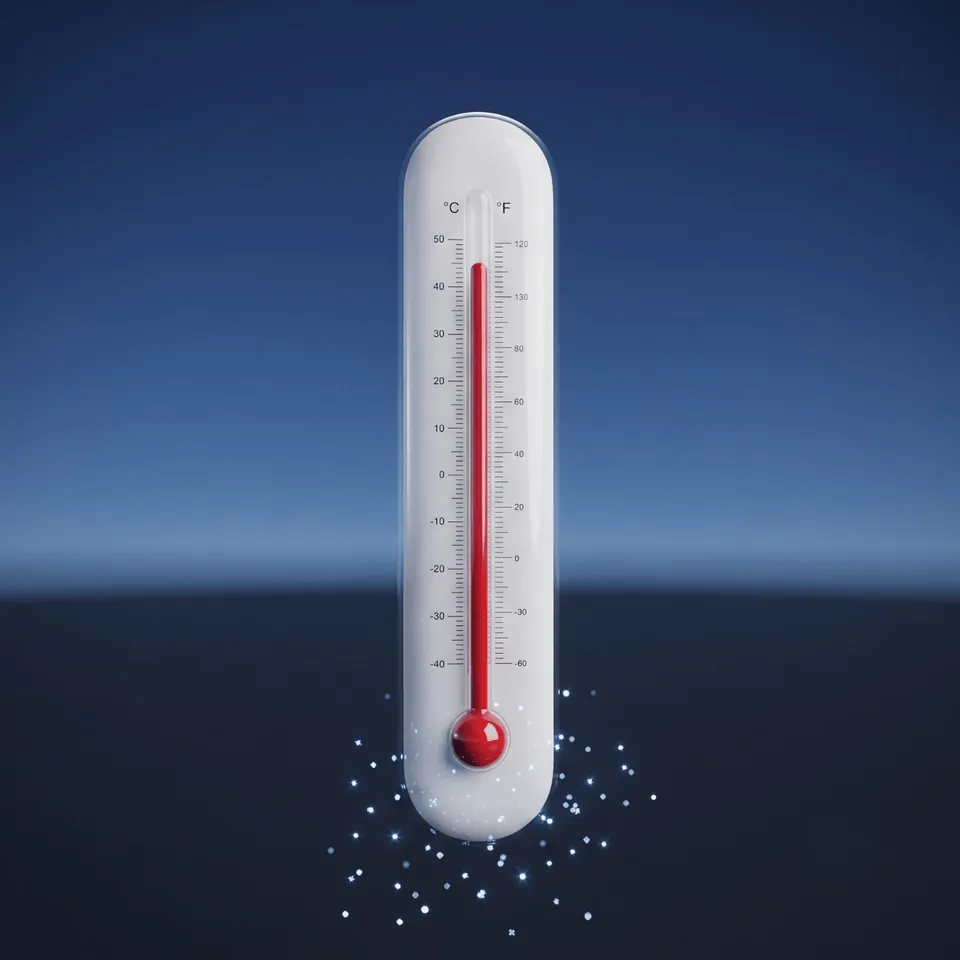
Laboratory Thermometer
Science · Chapter · 2 min 44 sec · English, Hindi, Gujarati, Marathi
See how a laboratory thermometer measures temperature: the liquid in its bulb expands and rises up a thin capillary tube when warm, and contracts when cold, against a scale in degrees Celsius and Fahrenheit.
What you will learn
- Explain why touch cannot tell exactly how hot or cold something is
- Name the parts of a laboratory thermometer and its °C and °F scales
- Explain how the liquid expands when heated and contracts when cooled
- Read a thermometer correctly, with your eye level with the liquid
Key terms
- Temperature
- How hot or cold an object is
- Laboratory thermometer
- An instrument that measures temperature
- Bulb
- The bottom part that holds the liquid
- Capillary tube
- The very thin glass tube the liquid rises in
- Expansion
- Getting bigger when heated, so the liquid rises
- Clinical thermometer
- Used by doctors; normal body temperature is about 37 °C
Inside this chapter
- 0:01 Measuring hot and cold Our skin is easily fooled about hot and cold. The degree of hotness or coldness of an object is its temperature, and a thermometer is the instrument that measures it.
- 0:33 Parts of the thermometer A bulb at the bottom holds the liquid, coloured alcohol here or mercury in some thermometers. A thin capillary tube rises from it beside a scale in degrees Celsius and Fahrenheit.
- 1:04 Why the liquid moves Warmth makes the liquid expand and rise; cold makes it contract and fall. The top of the column gives the reading. Water freezes at 0°C, or 32°F, and at -40 both scales match.
- 1:33 Reading it correctly First work out what one small division is worth, here 1°C. Keep your eye level with the top of the liquid, because looking from above or below gives a wrong reading.
- 1:45 Thermometers in daily life Thermometers are used in laboratories, weather stations and kitchens. Doctors use a clinical thermometer, and normal body temperature is about 37°C.
- 2:19 Hold it by the top Hold a thermometer by its top, not by the bulb. The warmth of your hand would change the reading.
Read more on the blog
More chapters
- The Fundamental Unit of Life: Look inside the cell, the basic unit of all living things, explore the organelles that keep it working, and compare prokaryotic and eukaryotic, plant and animal cells.
- Onion Peel Experiment: Prepare an onion peel slide step by step and look through a microscope at real plant cells, with their cell wall, cell membrane and nucleus.
- Bone: The Body's Hard Framework: Look into a piece of bone, cut open, and one tiny unit of it, magnified. Open its rings of hard matrix to find the bone cells and the blood vessels in its canal, and see why bone is strong, rigid and supports the body.
- Epidermis and Stomata: The Leaf's Outer Layer: Open the tiny pores in the outer layer of a leaf and watch gases pass in and out and water vapour escape. Meet the flat, tightly packed cells of the epidermis and its waxy cuticle, then close the stomata again.