Magnetic Effects of Electric Current
Science · Chapter · 4 min 17 sec · English, Hindi, Gujarati, Marathi
Discover how an electric current makes a magnetic field: field lines around a wire, the right-hand thumb rule, a solenoid that acts like a bar magnet, and how an electric motor works.
NCERT and CBSE · Class 10 Science · Chapter 12: Magnetic Effects of Electric Current
What you will learn
- Observe the magnetic field around a current-carrying conductor
- Use the right-hand thumb rule to find field direction
- Explain how a solenoid acts like a bar magnet
- Understand the working principle of an electric motor
Key terms
- Magnetic field
- The region around a magnet or current where force acts
- Solenoid
- A coil of wire that becomes a magnet when current flows
- Electromagnet
- A magnet produced by an electric current
- Fleming's left-hand rule
- Gives the direction of force on a current
Inside this chapter
- 0:00 Magnetic field The space around a magnet where it can act on other things is its magnetic field.
- 0:33 Field lines Iron filings line up along field lines, which leave the north pole and enter the south pole. Where the lines are crowded the field is stronger, and lines never cross.
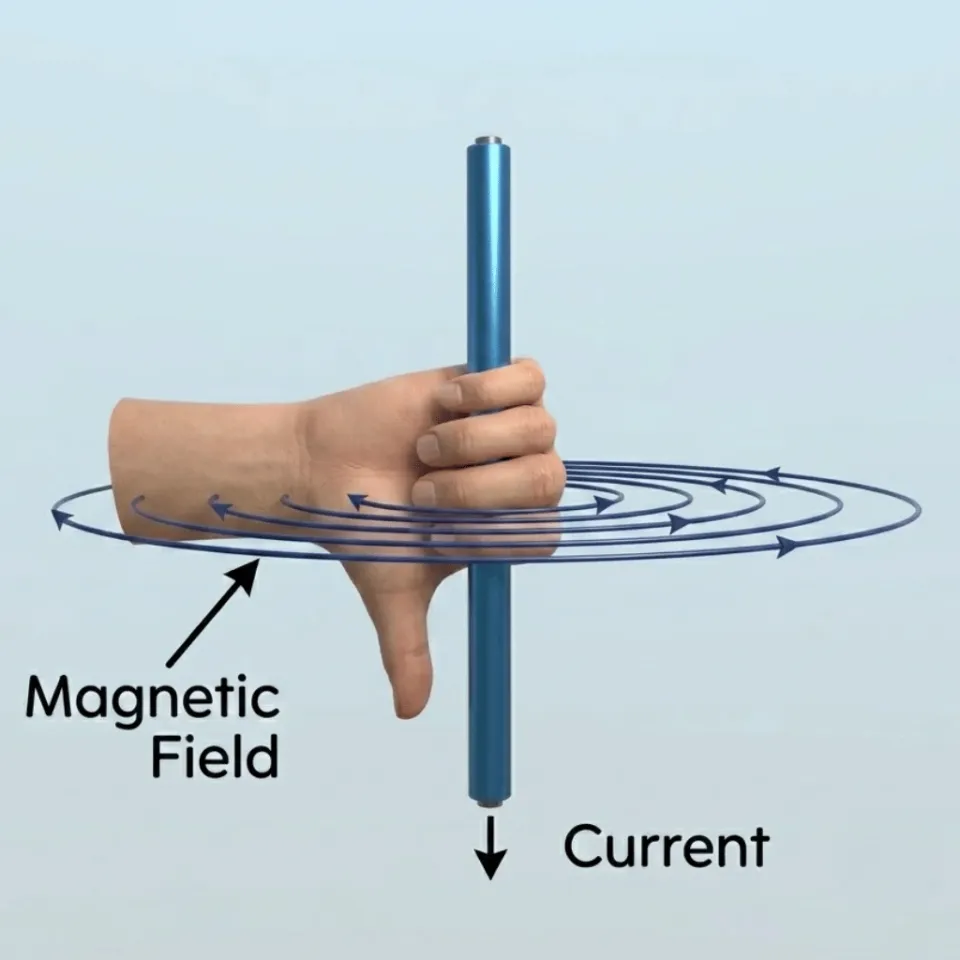
- 1:05 Right-hand thumb rule Hold a current-carrying wire in your right hand with the thumb along the current. Your curled fingers show the direction of the magnetic field around it.
- 1:58 A loop of wire Bend the wire into a loop and the field is strongest at its centre. This idea is behind the electromagnets in motors and speakers.
- 2:27 Fleming's left-hand rule Hold thumb, forefinger and middle finger at right angles. With the forefinger along the field and the middle finger along the current, the thumb shows the force. This is how electric motors spin.
- 3:18 Wiring at home Homes get a live wire (red), a neutral wire (black) and an earth wire (green) that protects us from shocks. A fuse melts and cuts the power if too much current flows.
- 3:41 Circuits and uses Homes have a 15 A circuit for heavy appliances and a 5 A circuit for lights and fans. Motors and electromagnets, from cranes to MRI machines, use these ideas.
Read more on the blog
- CBSE Class 10 Physics: Visualizing Magnetic Effects of Electric Current in 3D
- CBSE Class 10 Physics Practicals in 3D: Ray Optics, Electricity, and Magnetic Effects
More chapters
- Magnet Activity: Experiment with magnets to reveal invisible magnetic field lines, see like poles repel and unlike poles attract, and watch a compass needle respond.
- Chemical Reactions and Equations: Learn to recognise a chemical reaction, write and balance chemical equations, and tell combination, decomposition and displacement reactions apart, with oxidation and reduction.
- Combination Reaction: Magnesium: Light a burner and hold a magnesium ribbon in the flame. Watch it burn with a dazzling white light and turn into white magnesium oxide in a combination reaction.
- Exothermic Reaction: Quicklime: Add quicklime to a beaker and pour water on it. Watch it hiss, steam and crumble into slaked lime as the temperature shoots up, then whitewash a wall with it.