Matter in Our Surroundings
Science · Chapter · 4 min 24 sec · English, Hindi, Gujarati, Marathi
Explore the three states of matter and see how heating, cooling and the movement of particles cause melting, boiling and evaporation in the things around us.
What you will learn
- Classify matter as solid, liquid or gas by its properties
- Explain changes of state with temperature
- Understand evaporation, melting and boiling
- Relate particle movement to states of matter
Key terms
- Matter
- Anything that has mass and occupies space
- Evaporation
- Liquid changing to vapour below boiling point
- Melting point
- Temperature at which a solid becomes liquid
- Diffusion
- Mixing of particles due to their own motion
Inside this chapter
- 0:00 Matter and its particles Anything that takes up space and has mass is matter, from a rock to the air we breathe. It is made of tiny particles: salt seems to vanish in water, but it is still there, between the water particles.
- 0:29 Particles spread out A tiny bit of a purple crystal colours all the water, and the smell of incense fills a room, because particles are very small and spread out quickly. Heating makes them spread even faster.
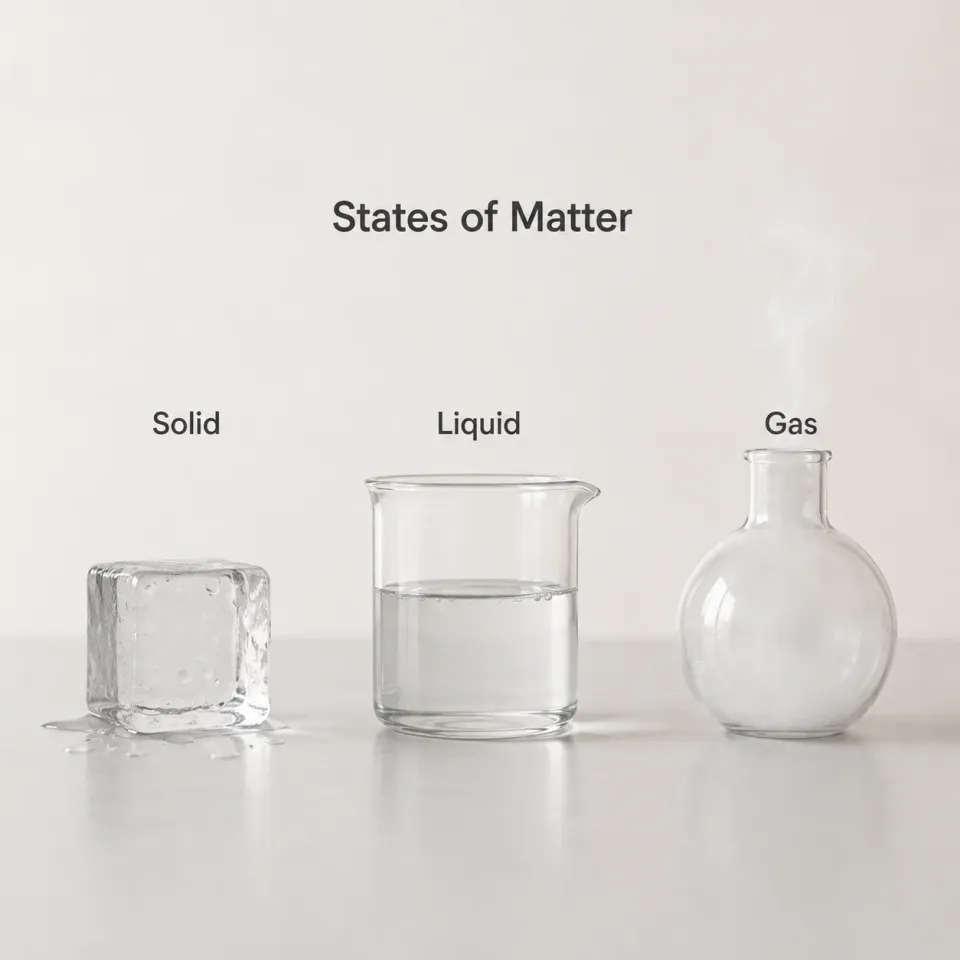
- 0:59 Three states of matter Particles have spaces between them, are always moving and attract each other. Tightly packed particles let solids keep their shape, close but moving particles let liquids flow, and free, fast particles let gases spread out.
- 1:37 Melting, boiling and latent heat Heat makes particles move faster. Ice melts at 0°C and water boils at 100°C, and the hidden heat that overcomes the attraction between particles is called latent heat.
- 2:13 Sublimation, deposition and pressure Camphor and dry ice change straight from solid to gas, called sublimation, and frost forms by deposition, a gas turning straight into a solid. Compressing and cooling a gas turns it into a liquid, which is how LPG is liquefied.
- 2:44 Evaporation cools Evaporation is a liquid turning into vapour at its surface, even below its boiling point. The fastest particles escape and take heat with them, so evaporation cools things down.
- 3:17 What speeds up evaporation A larger surface area, a higher temperature, wind and dry air all make a liquid evaporate faster. Humid air already holds a lot of vapour, so it slows evaporation down.
More chapters
- The Fundamental Unit of Life: Look inside the cell, the basic unit of all living things, explore the organelles that keep it working, and compare prokaryotic and eukaryotic, plant and animal cells.
- Onion Peel Experiment: Prepare an onion peel slide step by step and look through a microscope at real plant cells, with their cell wall, cell membrane and nucleus.
- Bone: The Body's Hard Framework: Look into a piece of bone, cut open, and one tiny unit of it, magnified. Open its rings of hard matrix to find the bone cells and the blood vessels in its canal, and see why bone is strong, rigid and supports the body.
- Epidermis and Stomata: The Leaf's Outer Layer: Open the tiny pores in the outer layer of a leaf and watch gases pass in and out and water vapour escape. Meet the flat, tightly packed cells of the epidermis and its waxy cuticle, then close the stomata again.