Motion
Science · Chapter · 2 min 55 sec · English, Hindi, Gujarati, Marathi
Describe motion with distance, displacement, speed, velocity and acceleration, read distance-time and velocity-time graphs, and use the equations of uniformly accelerated motion.
NCERT and CBSE · Class 9 Science · Chapter 4: Describing Motion Around Us
What you will learn
- Distinguish between distance and displacement
- Define speed, velocity and acceleration
- Interpret distance-time and velocity-time graphs
- Apply the equations of uniformly accelerated motion
Key terms
- Speed
- Distance travelled per unit time
- Velocity
- Speed in a given direction
- Acceleration
- The rate of change of velocity
- Displacement
- Shortest distance from start to end, with direction
Inside this chapter
- 0:00 Motion and a reference point Birds fly, cars move and the Earth spins, so motion is all around us. To describe it we need a reference point called the origin: if a school is 2 km west of a house, the house can be the origin.
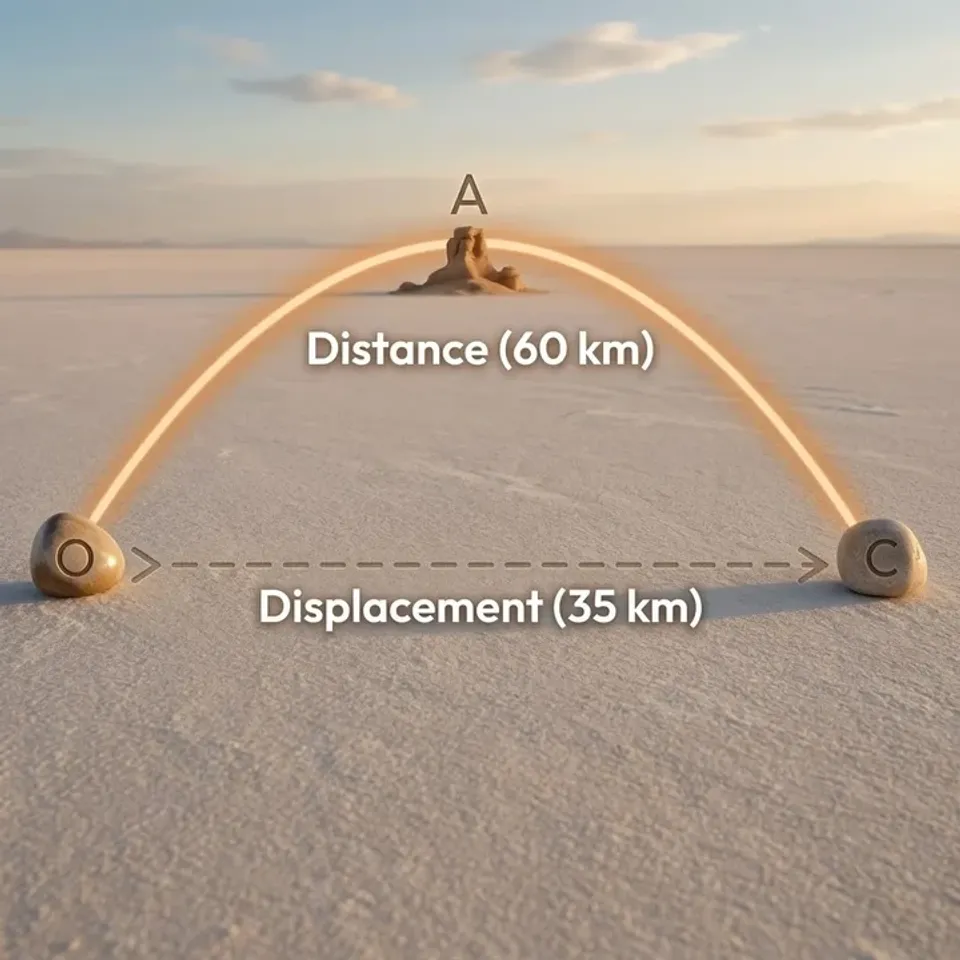
- 0:34 Distance and displacement Distance is the total length of the path covered, and it can never be negative. Displacement is the shortest straight line from start to end, so it is zero if you come back to where you started.
- 1:00 Uniform motion, speed and velocity Covering equal distances in equal intervals of time is uniform motion, and changing pace is non-uniform motion. Speed tells how fast something moves, while velocity tells how fast and in which direction.
- 1:23 Averages and acceleration Average speed is total distance divided by total time, and average velocity is displacement divided by time. Acceleration is the rate of change of velocity, so speeding up, slowing down or changing direction all count.
- 1:53 Graphs and equations of motion A straight line on a distance-time graph shows uniform speed and a curve shows non-uniform speed, while the area under a velocity-time graph gives the distance travelled. For uniform acceleration, three equations of motion work out the final velocity, time or distance.
- 2:28 Circular motion An object going round a circle at a steady speed keeps changing direction. So its velocity keeps changing, which makes circular motion accelerated motion too.
Read more on the blog
- Velocity-Time Graphs in 3D: Deriving Equations of Motion
- Newton's Laws of Motion in 3D: Real-Life Examples and Formulas
More chapters
- The Fundamental Unit of Life: Look inside the cell, the basic unit of all living things, explore the organelles that keep it working, and compare prokaryotic and eukaryotic, plant and animal cells.
- Onion Peel Experiment: Prepare an onion peel slide step by step and look through a microscope at real plant cells, with their cell wall, cell membrane and nucleus.
- Bone: The Body's Hard Framework: Look into a piece of bone, cut open, and one tiny unit of it, magnified. Open its rings of hard matrix to find the bone cells and the blood vessels in its canal, and see why bone is strong, rigid and supports the body.
- Epidermis and Stomata: The Leaf's Outer Layer: Open the tiny pores in the outer layer of a leaf and watch gases pass in and out and water vapour escape. Meet the flat, tightly packed cells of the epidermis and its waxy cuticle, then close the stomata again.