Muscular Tissue: How We Move
Science · Lab · 2 min 30 sec · English, Hindi, Gujarati, Marathi
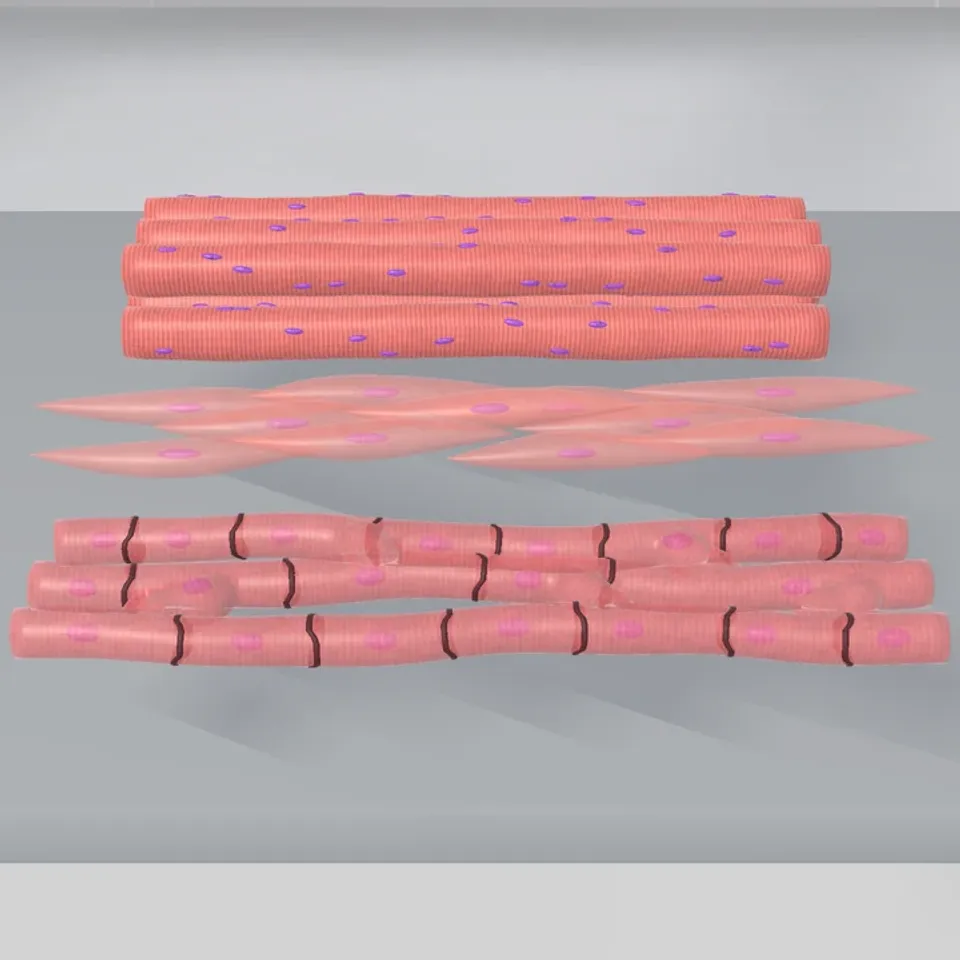
Make three kinds of muscle work: skeletal muscle that moves your bones when you want, smooth muscle that moves food on its own, and cardiac muscle that keeps your heart beating all your life. Compare their cells, nuclei and bands.
NCERT and CBSE · Class 9 Science · Chapter 3: Tissues in Action
What you will learn
- Explain how muscles move the body
- Describe skeletal muscle fibres and why they are called striated
- Describe smooth muscle cells and cardiac muscle fibres
- Tell voluntary from involuntary muscles
Key terms
- Muscle fibres
- The long cells that make up a muscle
- Skeletal muscle
- Muscle attached to the bones; long, unbranched fibres with many nuclei and light and dark bands
- Striated
- Showing light and dark bands
- Voluntary movement
- A movement we control, such as running or writing
- Smooth muscle
- Muscle of the stomach and intestines; spindle-shaped cells with one nucleus and no bands
- Cardiac muscle
- Muscle found only in the heart; branched fibres with one nucleus that work all life without tiring
- Involuntary movement
- A movement that happens on its own, such as the heartbeat
Inside this lab
- 0:04 Skeletal muscle moves bones Muscles move the body by contracting, as their fibres shorten and then relax. Skeletal muscle, attached to the bones, has long, cylindrical, unbranched fibres with many nuclei and light and dark bands, so it is called striated.
- 0:35 Smooth muscle works on its own Smooth muscle is found in organs such as the stomach and intestines, where it moves food along on its own. Its spindle-shaped cells each have one nucleus and no bands, and they contract slowly, again and again.
- 1:10 Cardiac muscle in the heart Cardiac muscle is found only in the heart. Its fibres are cylindrical and branched, and each cell has one nucleus and faint bands.
- 1:46 A beat that never tires Cardiac muscle contracts and relaxes in a steady rhythm. This keeps the heart beating all through life without getting tired.
- 2:01 Voluntary and involuntary Skeletal muscle is voluntary: we control it when we run, write or lift. Smooth muscle and cardiac muscle are involuntary and work without our control.
Read more on the blog
More chapters
- Bone: The Body's Hard Framework: Look into a piece of bone, cut open, and one tiny unit of it, magnified. Open its rings of hard matrix to find the bone cells and the blood vessels in its canal, and see why bone is strong, rigid and supports the body.
- Epidermis and Stomata: The Leaf's Outer Layer: Open the tiny pores in the outer layer of a leaf and watch gases pass in and out and water vapour escape. Meet the flat, tightly packed cells of the epidermis and its waxy cuticle, then close the stomata again.
- Sclerenchyma: The Hard, Strong Tissue: Lift a long, narrow cell out of a block of plant tissue and see its thick wall of lignin, with hardly any space inside. Put a weight on the tissue: it does not bend. Find where this hard tissue is found, from leaf veins to coconut husk.
- Meristematic Tissue: How Plants Grow: Tap a growing plant to find where it grows: its shoot and root tips grow longer, its stem grows thicker, and a cut stem grows back. Then look at the dividing meristem cells up close.