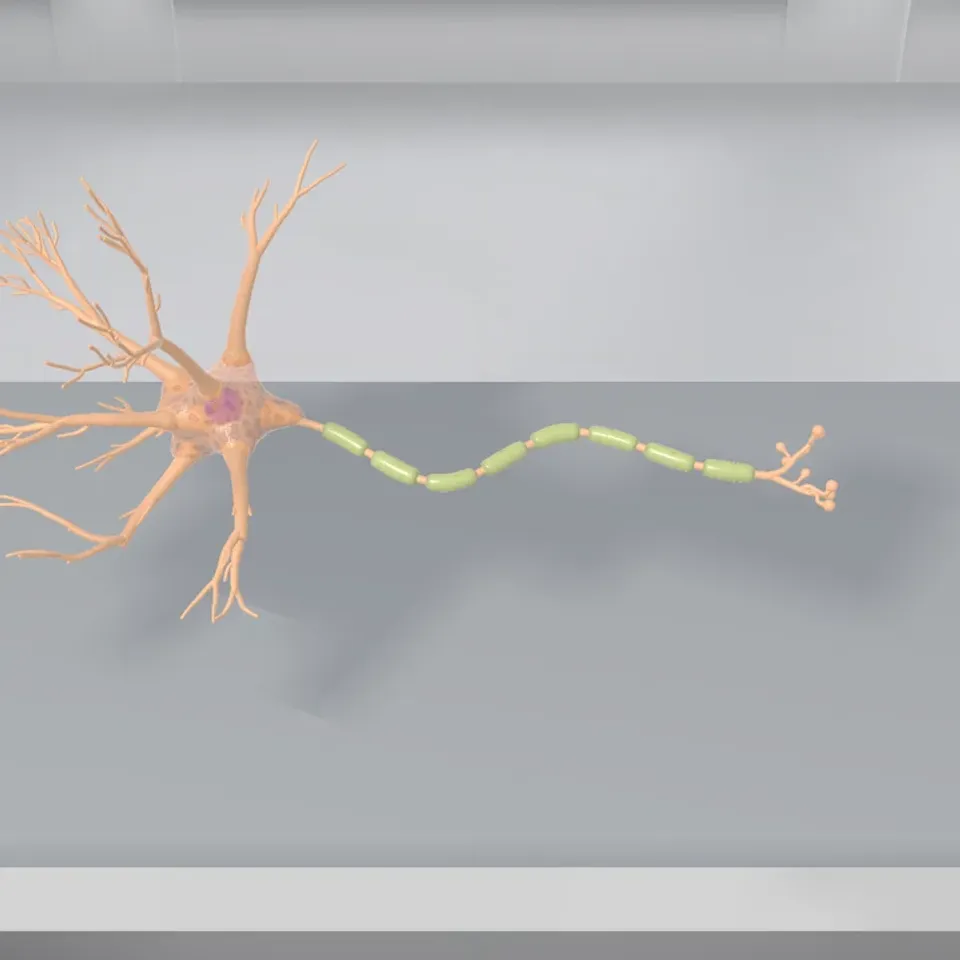
Neuron: The Body's Messenger
Science · Lab · 2 min 15 sec · English, Hindi, Gujarati, Marathi
Send a message through a nerve cell. Watch it come in at the dendrites, pass the cell body, run along the axon and leave at the axon terminals, and find out how nervous tissue links and controls the whole body.
NCERT and CBSE · Class 9 Science · Chapter 3: Tissues in Action
What you will learn
- Name the cells of nervous tissue
- Identify the cell body, nucleus, dendrites, axon and axon terminals of a neuron
- State the job of each part of a neuron
- Explain how nervous tissue controls the body
Key terms
- Nervous tissue
- The tissue that links and controls the body; its cells are neurons
- Neuron
- A nerve cell, made to receive, process and pass on messages
- Cell body
- The part of a neuron with the nucleus; it controls the cell
- Dendrites
- Short branches of a neuron that receive messages from other neurons
- Axon
- The long fibre of a neuron that carries the message away from the cell body
- Axon terminals
- The ends of the axon, which pass the message on to other cells
Inside this lab
- 0:03 Dendrites and the cell body A neuron is a nerve cell. Its short branches, the dendrites, receive messages from other neurons and pass them to the cell body, whose nucleus controls the cell.
- 0:30 The axon One long fibre, the axon, leaves the cell body. It carries the message away from the cell body, very quickly.
- 0:48 Axon terminals At its end the axon splits into branches called axon terminals. They pass the message on to another cell, such as a neuron or a muscle.
- 1:03 Nervous tissue Neurons make up nervous tissue, a network across the whole body with the brain as its control centre. Touch something hot and neurons carry the message fast, so you pull away.
- 1:30 The path of a message A message comes in at the dendrites, reaches the cell body, runs along the axon and is passed on by the axon terminals.
Read more on the blog
- Tissues in Action Class 9: Chapter Guide With 3D Views
- Reflex Arc 3D Model and Animation: Class 10 Control and Coordination Explained
More chapters
- Bone: The Body's Hard Framework: Look into a piece of bone, cut open, and one tiny unit of it, magnified. Open its rings of hard matrix to find the bone cells and the blood vessels in its canal, and see why bone is strong, rigid and supports the body.
- Epidermis and Stomata: The Leaf's Outer Layer: Open the tiny pores in the outer layer of a leaf and watch gases pass in and out and water vapour escape. Meet the flat, tightly packed cells of the epidermis and its waxy cuticle, then close the stomata again.
- Sclerenchyma: The Hard, Strong Tissue: Lift a long, narrow cell out of a block of plant tissue and see its thick wall of lignin, with hardly any space inside. Put a weight on the tissue: it does not bend. Find where this hard tissue is found, from leaf veins to coconut husk.
- Meristematic Tissue: How Plants Grow: Tap a growing plant to find where it grows: its shoot and root tips grow longer, its stem grows thicker, and a cut stem grows back. Then look at the dividing meristem cells up close.