Parenchyma: The Living Filler Tissue
Science · Lab · 2 min 30 sec · English, Hindi, Gujarati, Marathi
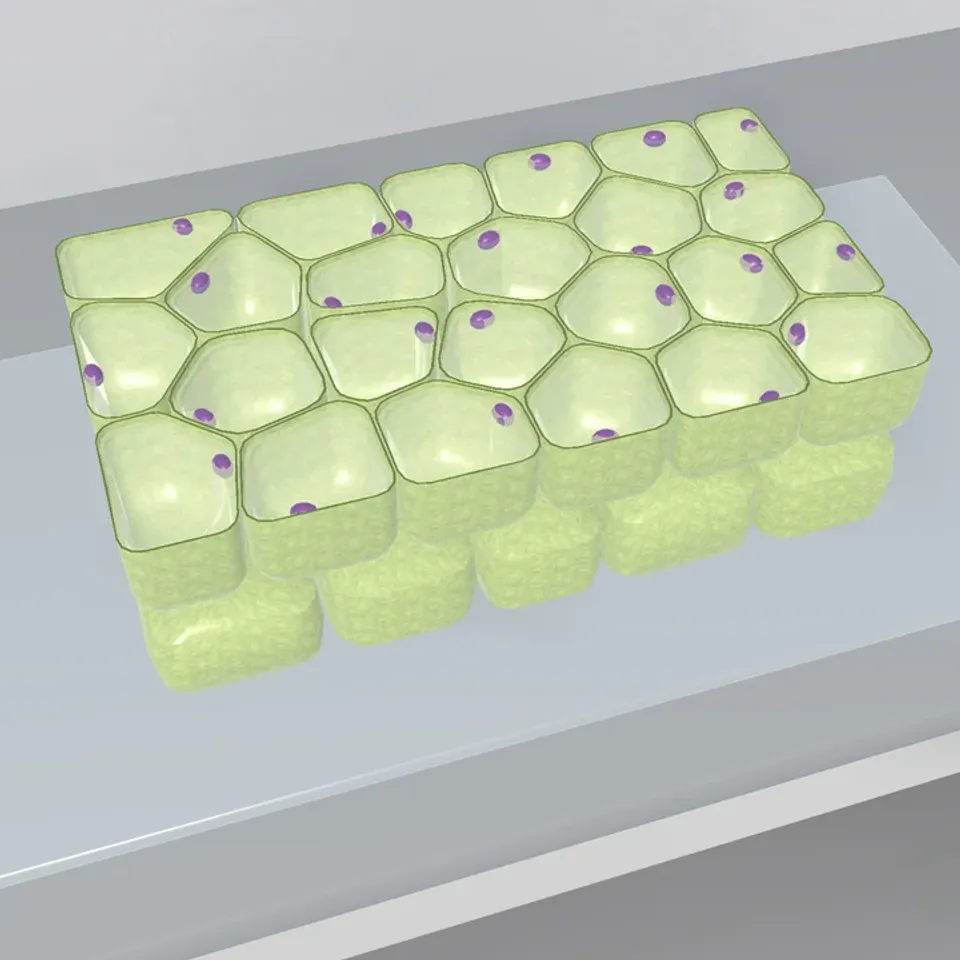
Lift a cell out of a block of plant tissue and look inside it: a thin wall, cytoplasm, a nucleus and a large vacuole. See the spaces between the loosely packed cells, the chloroplasts of green parenchyma, and the air spaces that help water plants float.
NCERT and CBSE · Class 9 Science · Chapter 3: Tissues in Action
What you will learn
- Describe the cells of parenchyma
- Explain why parenchyma is a simple permanent tissue
- Identify the intercellular spaces between parenchyma cells
- State the jobs of parenchyma: storing food, photosynthesis, helping water plants float
Key terms
- Parenchyma
- A simple permanent tissue of living cells with thin walls
- Simple permanent tissue
- A permanent tissue made of only one kind of cell
- Intercellular spaces
- The spaces between loosely packed cells
- Vacuole
- The large sac of cell sap in the middle of a plant cell
- Chloroplast
- The green part of a cell, with chlorophyll, where food is made by photosynthesis
- Air spaces
- Large spaces in the parenchyma of water plants that help them float
Inside this lab
- 0:03 A living, thin-walled cell Each cell has a thin cell wall, cytoplasm, a nucleus and a large vacuole in the middle. A tissue made of living cells with thin walls like these is called parenchyma.
- 0:29 A simple permanent tissue All of its cells are of one kind, so parenchyma is a simple permanent tissue. The cells are loosely packed, with intercellular spaces between them.
- 0:42 Storing and making food Parenchyma mainly stores food in its cells. In green parts such as leaves, its cells have chloroplasts with green chlorophyll and make food by photosynthesis.
- 1:13 Air spaces help it float In water plants like the lotus, the spaces between the cells grow into large air spaces. The air makes the plant light, so it floats.
Read more on the blog
More chapters
- Bone: The Body's Hard Framework: Look into a piece of bone, cut open, and one tiny unit of it, magnified. Open its rings of hard matrix to find the bone cells and the blood vessels in its canal, and see why bone is strong, rigid and supports the body.
- Epidermis and Stomata: The Leaf's Outer Layer: Open the tiny pores in the outer layer of a leaf and watch gases pass in and out and water vapour escape. Meet the flat, tightly packed cells of the epidermis and its waxy cuticle, then close the stomata again.
- Sclerenchyma: The Hard, Strong Tissue: Lift a long, narrow cell out of a block of plant tissue and see its thick wall of lignin, with hardly any space inside. Put a weight on the tissue: it does not bend. Find where this hard tissue is found, from leaf veins to coconut husk.
- Meristematic Tissue: How Plants Grow: Tap a growing plant to find where it grows: its shoot and root tips grow longer, its stem grows thicker, and a cut stem grows back. Then look at the dividing meristem cells up close.