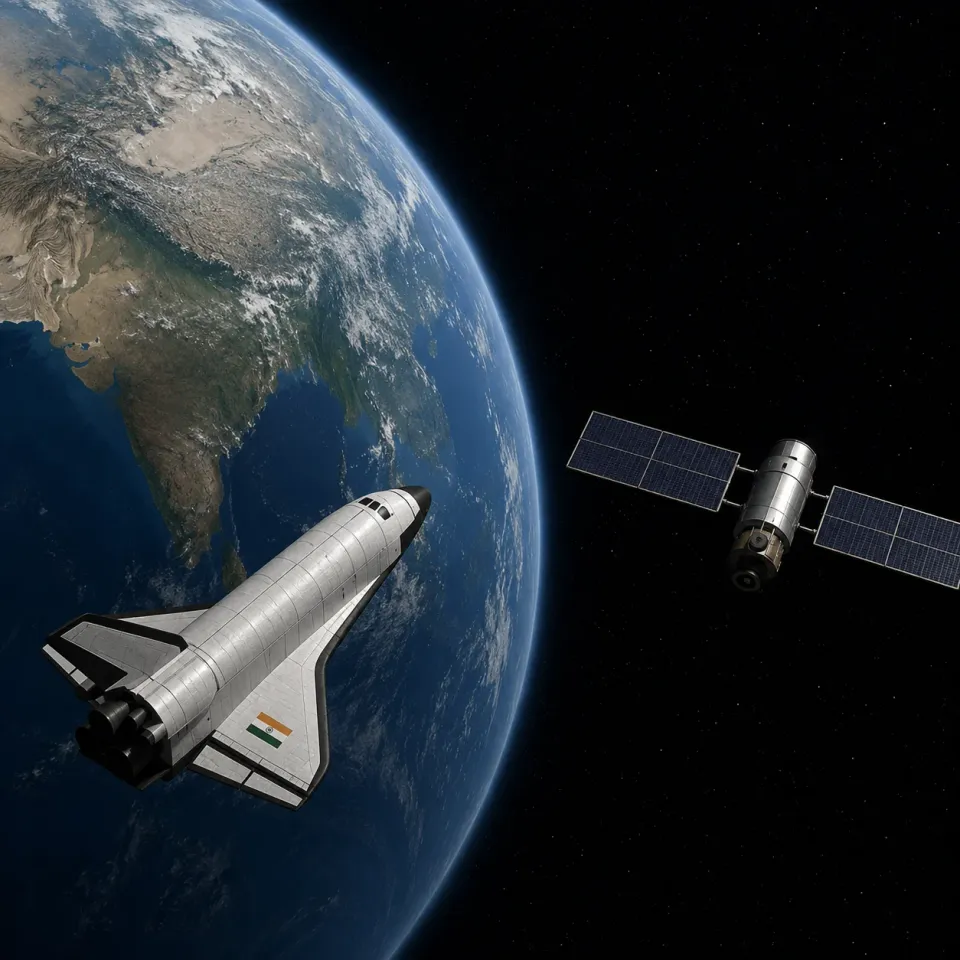
Explore Space
Science · Chapter · 3 min 12 sec · English, Hindi, Gujarati, Marathi
Travel through the solar system: the Sun, the planets and their moons, and the stars beyond, and see how gravity keeps everything moving in its orbit.
What you will learn
- Identify the planets and their order from the Sun
- Compare terrestrial planets with gas giants
- Understand how gravity holds the solar system together
- Explore stars, galaxies and how we observe space
Key terms
- Orbit
- The fixed path a body follows around the Sun
- Galaxy
- A huge system of stars, gas and dust bound by gravity
- Satellite
- A body that orbits a planet
- Star
- A glowing ball of gas that gives out light and heat
Inside this chapter
- 0:00 No sound in space Space has no air to carry sound, so nothing can be heard there. Gravity, the force that pulls objects towards each other, still acts in space.
- 0:28 Weightless in orbit Gravity keeps the space station circling Earth. In orbit, astronauts are always in free fall, so they feel weightless and float.
- 0:57 Keeping the air in Inside the station, people and loose objects float. An airlock keeps one door shut while the other is open, so the station's air cannot escape into space.
- 1:30 What a space suit does To step outside through the airlock, an astronaut needs a special space suit. It supplies oxygen and drinking water, removes carbon dioxide, and protects against extreme temperatures and the Sun's radiation.
- 2:17 Why space looks dark Space looks dark because there is no air to scatter sunlight. Harsh conditions like these are why every astronaut needs a space suit.
Read more on the blog
More chapters
- Chemical Reactions and Equations: Learn to recognise a chemical reaction, write and balance chemical equations, and tell combination, decomposition and displacement reactions apart, with oxidation and reduction.
- Combination Reaction: Magnesium: Light a burner and hold a magnesium ribbon in the flame. Watch it burn with a dazzling white light and turn into white magnesium oxide in a combination reaction.
- Exothermic Reaction: Quicklime: Add quicklime to a beaker and pour water on it. Watch it hiss, steam and crumble into slaked lime as the temperature shoots up, then whitewash a wall with it.
- Human Heart: See how the heart pumps blood around the body: its four chambers, the valves that keep blood flowing one way, and the double circulation through the lungs and the body.