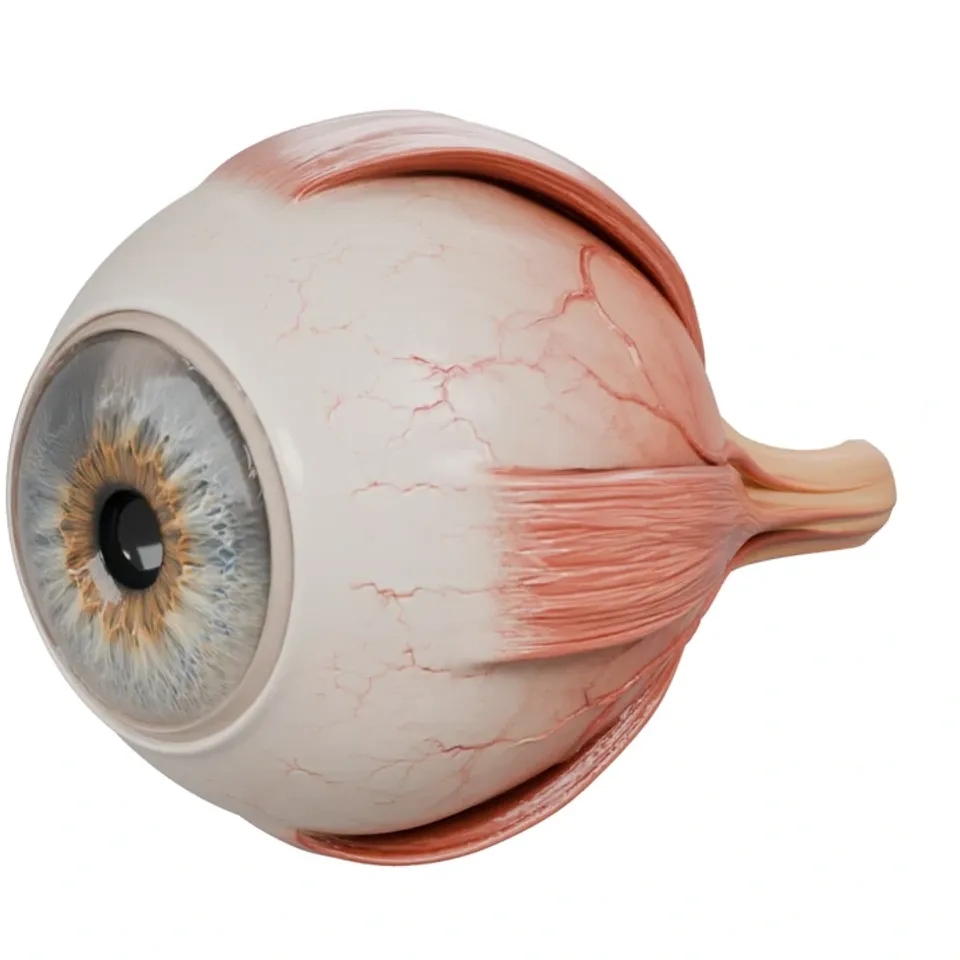
Human Eye
Science · Lab · At your own pace · English
Turn a 3D model of the human eye and see how light passes through the cornea, pupil and lens to form an image on the retina, and how the iris and ciliary muscles adjust what you see.
NCERT and CBSE · Class 10 Science · Chapter 10: The Human Eye and the Colourful World
What you will learn
- Name the parts light passes through: cornea, aqueous humour, lens and vitreous humour
- See how the iris changes the size of the pupil in bright and dim light
- Understand how the ciliary muscles change the shape of the lens to focus on near and far objects
- Find the rods and cones on the retina that sense light and colour
Key terms
- Cornea
- The clear front surface of the eye, where most of the bending of light happens
- Iris
- The coloured ring of muscle that controls the size of the pupil
- Retina
- The light-sensitive layer at the back of the eye, with rods and cones
- Optic nerve
- The nerve that carries signals from the retina to the brain
Read more on the blog
More chapters
- The Human Eye and the Colourful World: Explore how the human eye works and how it focuses on near and far objects, how lenses correct vision defects, and how dispersion and scattering of light give us the rainbow and the blue sky.
- Chemical Reactions and Equations: Learn to recognise a chemical reaction, write and balance chemical equations, and tell combination, decomposition and displacement reactions apart, with oxidation and reduction.
- Combination Reaction: Magnesium: Light a burner and hold a magnesium ribbon in the flame. Watch it burn with a dazzling white light and turn into white magnesium oxide in a combination reaction.
- Exothermic Reaction: Quicklime: Add quicklime to a beaker and pour water on it. Watch it hiss, steam and crumble into slaked lime as the temperature shoots up, then whitewash a wall with it.