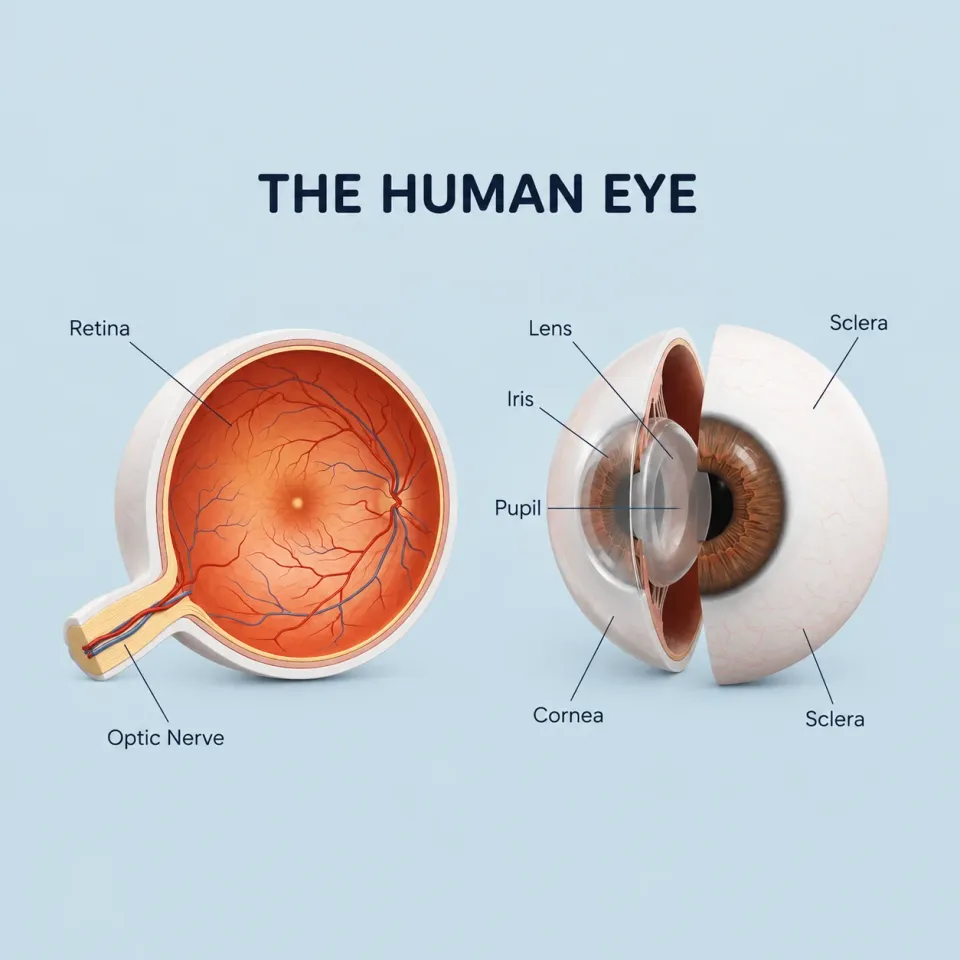
The Human Eye and the Colourful World
Science · Chapter · 3 min 24 sec · English, Hindi, Gujarati, Marathi
Explore how the human eye works and how it focuses on near and far objects, how lenses correct vision defects, and how dispersion and scattering of light give us the rainbow and the blue sky.
NCERT and CBSE · Class 10 Science · Chapter 10: The Human Eye and the Colourful World
What you will learn
- Identify the main parts of the human eye and their functions
- Explain how light forms a sharp image on the retina
- Describe how the eye focuses on near and distant objects
- Understand common vision defects and how lenses correct them
- Explain dispersion of light, the rainbow and the scattering of light
Key terms
- Cornea
- The transparent front layer that bends incoming light
- Lens
- Adjusts focus so the image lands sharply on the retina
- Retina
- Light-sensitive layer at the back that detects the image
- Iris
- Controls how much light enters through the pupil
- Dispersion
- The splitting of white light into its seven colours
Inside this chapter
- 0:00 The eye works like a camera Light enters through the cornea, the clear outer layer of the eye, which bends the light as it comes in.
- 0:29 Iris, lens and retina The iris sets the size of the pupil. The lens focuses light on the retina, which turns it into signals that travel to the brain along the optic nerve.
- 0:58 Defects of vision In myopia, far objects look blurry and a concave lens corrects it. In hypermetropia, near objects look blurry and a convex lens corrects it. Presbyopia comes with age.
- 1:28 How a rainbow forms Sunlight passing through raindrops splits into seven colours, VIBGYOR, because each colour bends by a slightly different amount.
- 2:03 Twinkling stars and an early sunrise Layers of air bend starlight by changing amounts, so stars seem to twinkle. The same bending lets us see the Sun a little before it has actually risen.
- 2:24 Why the sky is blue Tiny particles in the air scatter blue light much more than red, so the sky looks blue. At sunrise and sunset the light crosses more air and the Sun looks red.
Read more on the blog
More chapters
- Human Eye: Turn a 3D model of the human eye and see how light passes through the cornea, pupil and lens to form an image on the retina, and how the iris and ciliary muscles adjust what you see.
- Chemical Reactions and Equations: Learn to recognise a chemical reaction, write and balance chemical equations, and tell combination, decomposition and displacement reactions apart, with oxidation and reduction.
- Combination Reaction: Magnesium: Light a burner and hold a magnesium ribbon in the flame. Watch it burn with a dazzling white light and turn into white magnesium oxide in a combination reaction.
- Exothermic Reaction: Quicklime: Add quicklime to a beaker and pour water on it. Watch it hiss, steam and crumble into slaked lime as the temperature shoots up, then whitewash a wall with it.