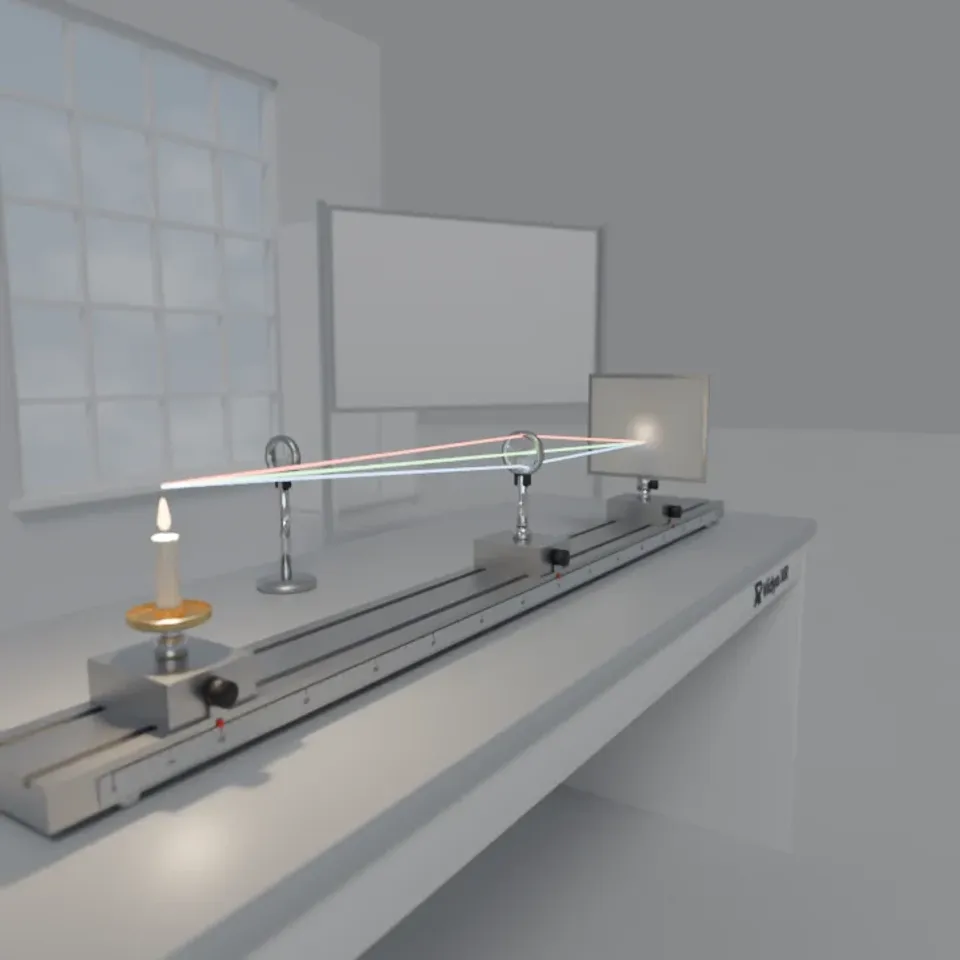
Image Formation by Lenses
Science · Lab · 7 min · English, Hindi, Gujarati, Marathi
Light a candle, move it along an optical bench and catch its image on a screen. See where a convex lens forms real, virtual, big and small images, then try a concave lens and explore on your own.
NCERT and CBSE · Class 10 Science · Chapter 9, Light: Reflection and Refraction
What you will learn
- Find the image formed by a convex lens on a screen for different positions of the object
- Relate the object's position to the image's position, size and nature
- Recognise that a convex lens works as a magnifying glass when the object is inside F₁
- Describe the image formed by a concave lens: always virtual, erect and diminished
Key terms
- Convex lens
- A lens thicker at the middle that brings parallel rays together
- Concave lens
- A lens thinner at the middle that spreads rays apart
- Principal focus (F)
- The point where rays parallel to the axis meet after passing through a convex lens
- Optical centre (O)
- The centre of a lens; a ray through it goes straight on
- Real image
- Formed where rays meet; it can be caught on a screen and is inverted
- Virtual image
- Cannot be caught on a screen; seen by looking through the lens, and erect
Inside this lab
- 0:03 Set up the optical bench Light a candle and look at the convex lens from the side: it is thicker in the middle. A white screen beyond the lens catches the image.
- 0:28 Principal focus and focal length Parallel rays meet at one point after the lens, called the principal focus. A lens has one on each side, F1 and F2, and their distance from the centre of the lens is the focal length.
- 1:24 Candle far from the lens With the candle beyond 2F1, the image on the screen is upside down and smaller than the flame. An image you can catch on a screen is a real image.
- 2:00 Moving the candle closer At 2F1 the image is the same size as the flame. Between F1 and 2F1 it is bigger and farther away. At F1 the rays leave parallel, so no image forms.
- 3:02 Candle inside F1: a magnifying glass No image appears on the screen. Look through the lens instead: the candle looks big and upright. This virtual image is how a magnifying glass works.
- 3:41 The concave lens A concave lens is thinner in the middle. Wherever the candle is, it gives a small, upright, virtual image that cannot be caught on a screen.
Read more on the blog
- CBSE Class 10 Physics 3D Ray Diagrams & Light Simulation Guide
- CBSE Class 10 Physics Practicals in 3D: Ray Optics, Electricity, and Magnetic Effects
More chapters
- Light: Reflection and Refraction: Learn how light bounces off surfaces and bends as it passes into another medium: the laws of reflection, images formed by plane and spherical mirrors, and refraction and refractive index.
- Refraction through a Rectangular Glass Slab: Place a glass slab over an ink line, then trace a ray of light through it with pins. See light bend towards the normal in glass, come out parallel but shifted, and find that sin i / sin r stays the same.
- Image Formation by Spherical Mirrors: Light a candle and move it in front of a concave mirror on an optical bench; slide a small screen to catch its image. See where real, virtual, big and small images form, then look into a convex mirror at a pencil and explore on your own.
- Chemical Reactions and Equations: Learn to recognise a chemical reaction, write and balance chemical equations, and tell combination, decomposition and displacement reactions apart, with oxidation and reduction.