Image Formation by Spherical Mirrors
Science · Lab · 7 min · English, Hindi, Gujarati, Marathi
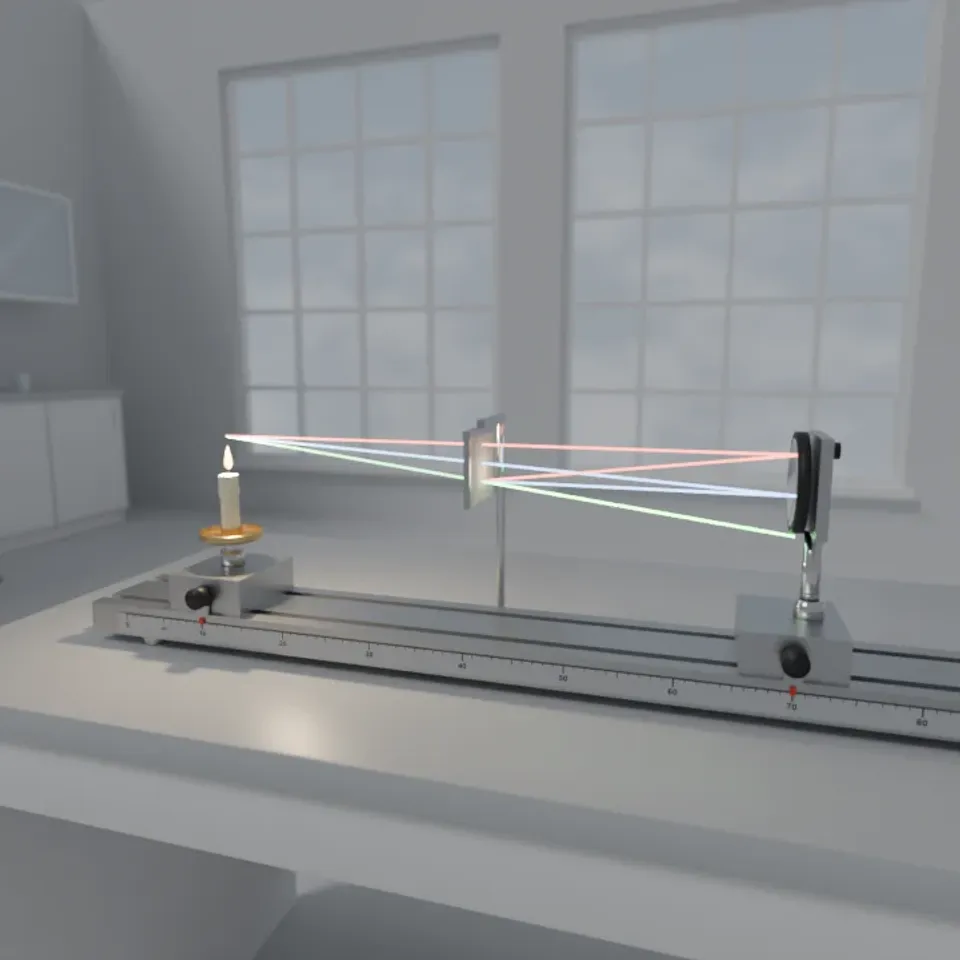
Light a candle and move it in front of a concave mirror on an optical bench; slide a small screen to catch its image. See where real, virtual, big and small images form, then look into a convex mirror at a pencil and explore on your own.
NCERT and CBSE · Class 10 Science · Chapter 9, Light: Reflection and Refraction
What you will learn
- Find the image formed by a concave mirror on a screen for different positions of the object
- Relate the object's position to the image's position, size and nature
- Recognise that a concave mirror gives an enlarged, erect image when the object is between P and F
- Describe the image formed by a convex mirror: always virtual, erect and diminished
Key terms
- Concave mirror
- A mirror curved inwards, like the inside of a spoon
- Convex mirror
- A mirror curved outwards; it gives a wider view
- Pole (P)
- The middle of the mirror's surface
- Principal focus (F)
- The point where rays parallel to the axis meet after reflection from a concave mirror
- Centre of curvature (C)
- The centre of the sphere the mirror is part of; it is twice as far as F
- Real image
- Formed where reflected rays meet; it can be caught on a screen and is inverted
- Virtual image
- Cannot be caught on a screen; seen in the mirror, and erect
Inside this lab
- 0:04 Set up the concave mirror A lit candle stands before a concave mirror in a dim room, where the image is easier to see. From the side, the mirror curves inwards, like the inside of a spoon.
- 0:27 Focus, pole and centre of curvature Parallel rays from far away meet at the principal focus F, and the distance from the pole P to F is the focal length f. The centre of curvature C is twice as far from the mirror as F.
- 1:15 Candle beyond C A screen catches a sharp image of the flame between F and C. It is inverted and diminished, and because it forms on a screen, it is a real image.
- 1:48 Moving the candle closer With the candle at C, a real, inverted image of the same size forms at C. Between C and F, the image is real, inverted and enlarged and lies beyond C; at F, the rays leave parallel and no image forms.
- 2:46 Inside F: a shaving mirror With the candle between F and the mirror, nothing shows on the screen. In the mirror you see a large, upright flame behind it, a virtual, erect and enlarged image used in shaving mirrors and by dentists.
- 3:19 The convex mirror A convex mirror bulges outwards. A pencil in front of it looks smaller and upright: the image is virtual, erect and diminished, and lies behind the mirror between P and F.
- 3:43 Why cars use convex mirrors As the pencil moves away, its image shrinks and moves closer to F. A convex mirror always gives a virtual, erect, diminished image, which is why cars use one as a rear-view mirror.
Read more on the blog
- CBSE Class 10 Physics 3D Ray Diagrams & Light Simulation Guide
- CBSE Class 10 Physics Practicals in 3D: Ray Optics, Electricity, and Magnetic Effects
More chapters
- Light: Reflection and Refraction: Learn how light bounces off surfaces and bends as it passes into another medium: the laws of reflection, images formed by plane and spherical mirrors, and refraction and refractive index.
- Image Formation by Lenses: Light a candle, move it along an optical bench and catch its image on a screen. See where a convex lens forms real, virtual, big and small images, then try a concave lens and explore on your own.
- Refraction through a Rectangular Glass Slab: Place a glass slab over an ink line, then trace a ray of light through it with pins. See light bend towards the normal in glass, come out parallel but shifted, and find that sin i / sin r stays the same.
- Chemical Reactions and Equations: Learn to recognise a chemical reaction, write and balance chemical equations, and tell combination, decomposition and displacement reactions apart, with oxidation and reduction.