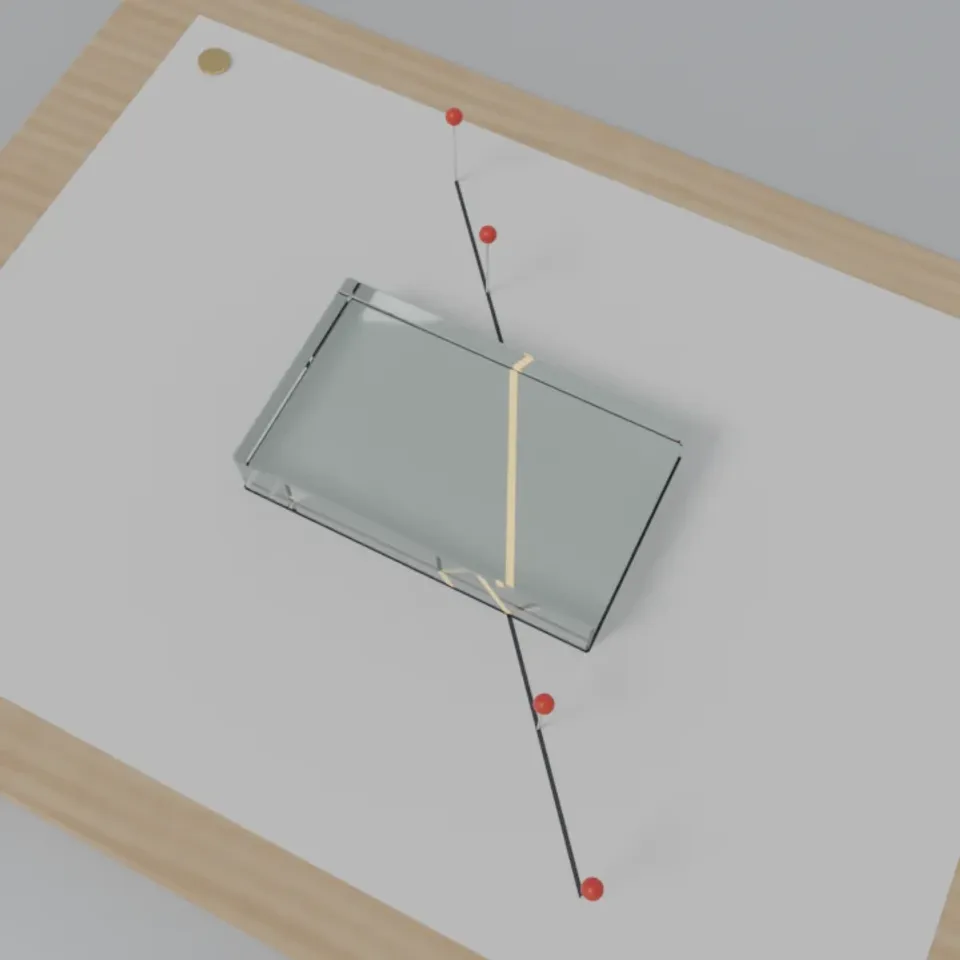
Refraction through a Rectangular Glass Slab
Science · Lab · 7 min · English, Hindi, Gujarati, Marathi
Place a glass slab over an ink line, then trace a ray of light through it with pins. See light bend towards the normal in glass, come out parallel but shifted, and find that sin i / sin r stays the same.
NCERT and CBSE · Class 10 Science · Chapter 9, Light: Reflection and Refraction
What you will learn
- Trace the path of a ray of light through a rectangular glass slab with pins
- Identify the incident ray, the refracted ray, the emergent ray and the normals
- Explain why the emergent ray is parallel to the incident ray but shifted sideways
- State the laws of refraction and find sin i / sin r for glass
Key terms
- Refraction
- The change of direction of light going from one medium into another
- Normal
- The line at right angles to the surface where the light meets it
- Angle of incidence (i)
- The angle between the incident ray and the normal
- Angle of refraction (r)
- The angle between the refracted ray and the normal
- Emergent ray
- The ray that comes out of the slab
- Refractive index
- The constant sin i / sin r for a pair of media; 1.52 for crown glass
Inside this lab
- 0:03 A line that looks broken A glass slab laid at an angle over an ink line makes the line seem to break at its edges. With the slab square to the line it looks unbroken, but from the top it looks raised.
- 0:36 Tracing the path of light Light changes direction as it passes from one medium into another. This is refraction. Pins E, F, G and H, lined up through the slab on its outline ABCD, mark the path of light.
- 1:47 Incident, refracted and emergent rays The line from E to point O on edge AB is the incident ray. The line from O' on edge CD to H is the emergent ray, and OO', the path inside the glass, is the refracted ray.
- 2:22 Bending at each face At O, light passes from air into glass, a rarer to a denser medium, and bends towards the normal. At O', it passes from glass into air and bends away from the normal.
- 2:50 Parallel but shifted The emergent ray is parallel to the incident ray, because the bending at the two faces is equal and opposite. But it comes out shifted a little to one side.
- 3:00 Light along the normal With pin E moved onto the normal, the pins line up straight through the glass. Light falling along the normal passes through without bending.
- 3:31 Laws of refraction With i = 40° and r = 25°, sin i / sin r = 1.52. This ratio stays constant from air to glass and is the refractive index of glass. The incident ray, refracted ray and normal lie in one plane.
Read more on the blog
- CBSE Class 10 Physics Practicals in 3D: Ray Optics, Electricity, and Magnetic Effects
- CBSE Class 10 Physics 3D Ray Diagrams & Light Simulation Guide
More chapters
- Light: Reflection and Refraction: Learn how light bounces off surfaces and bends as it passes into another medium: the laws of reflection, images formed by plane and spherical mirrors, and refraction and refractive index.
- Image Formation by Lenses: Light a candle, move it along an optical bench and catch its image on a screen. See where a convex lens forms real, virtual, big and small images, then try a concave lens and explore on your own.
- Image Formation by Spherical Mirrors: Light a candle and move it in front of a concave mirror on an optical bench; slide a small screen to catch its image. See where real, virtual, big and small images form, then look into a convex mirror at a pencil and explore on your own.
- Chemical Reactions and Equations: Learn to recognise a chemical reaction, write and balance chemical equations, and tell combination, decomposition and displacement reactions apart, with oxidation and reduction.