Control and Coordination
Science · Chapter · 4 min 2 sec · English, Hindi, Gujarati, Marathi
Learn how the nervous system and hormones work together to control the body: neurons and nerve impulses, reflex actions and the reflex arc, and the role of hormones.
NCERT and CBSE · Class 10 Science · Chapter 6: Control and Coordination
What you will learn
- Describe how the nervous system controls responses
- Explain the structure of a neuron and the nerve impulse
- Understand reflex actions and the reflex arc
- Identify the role of hormones in coordination
Key terms
- Neuron
- A nerve cell that carries messages as impulses
- Reflex action
- A quick, automatic response to a stimulus
- Hormone
- A chemical messenger secreted by glands
- Stimulus
- A change that triggers a response
Inside this chapter
- 0:00 Sensing the world Receptors in our sense organs detect heat, light, sound, smell and taste. The skin senses touch, pressure, heat and pain, and the ears sense both sound and balance.
- 0:48 How a nerve message travels An electrical impulse runs from a dendrite tip along the axon to the synapse, the gap between neurons. Chemicals carry it across to the next neuron, on to the brain or spinal cord.
- 1:14 Reflex actions Pulling back from a flame without thinking is a reflex action. Sensory neurons signal the spinal cord and motor neurons make the muscle react at once. This reflex arc protects us.
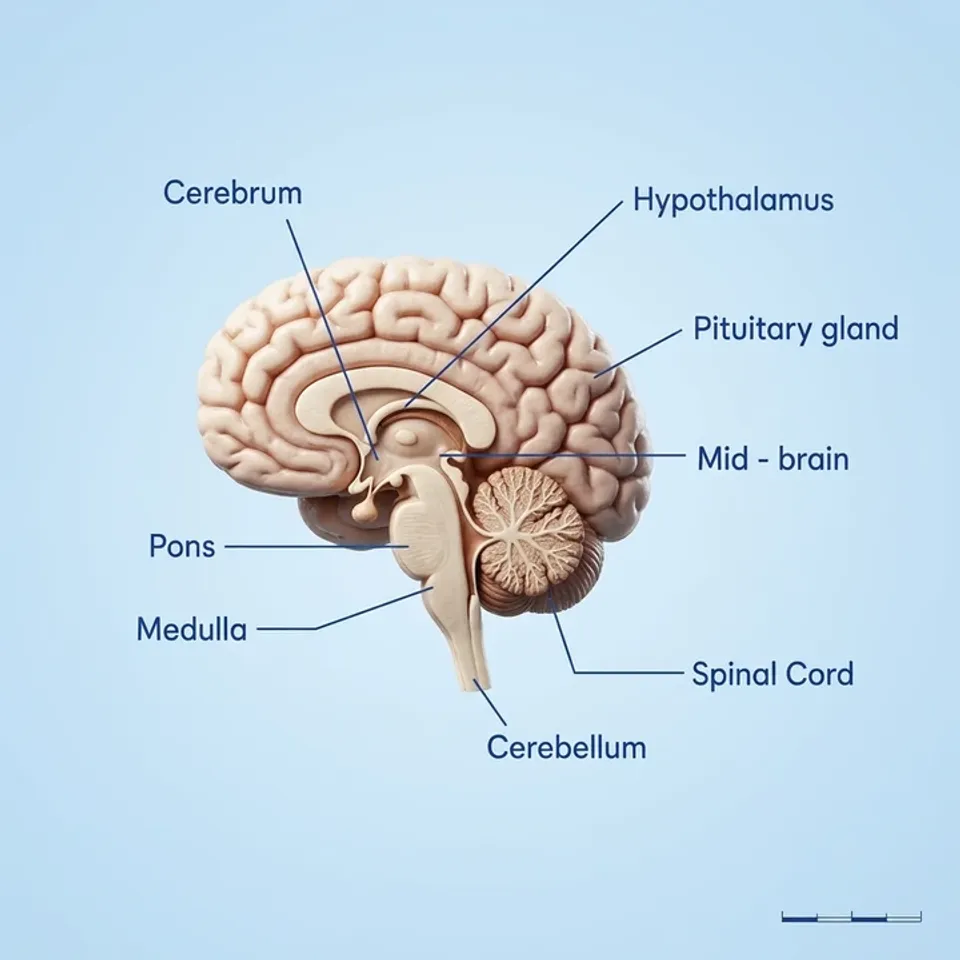
- 1:47 Three parts of the brain The forebrain handles thinking, memory, emotions and voluntary actions. The midbrain manages eye and ear reflexes, and the hindbrain controls balance, posture, breathing and heartbeat.
- 2:20 How plants respond Plants have no nerves. They respond by tropism, growth in response to light, gravity or touch, and by hormones: auxins lengthen cells and cytokinins promote cell division.
- 2:52 Hormones in animals In animals, endocrine glands release hormones, chemical messengers that control growth, metabolism and reproduction.
- 3:13 Key hormones Adrenaline readies the body for emergencies, insulin controls blood sugar and thyroxine controls metabolism. Oestrogen and testosterone control puberty and reproduction.
Read more on the blog
- Reflex Arc 3D Model and Animation: Class 10 Control and Coordination Explained
- Human Brain Diagram Class 10 in 3D: Parts, Functions and How to Draw It
More chapters
- Human Brain: Explore a 3D human brain: the fore-brain, mid-brain and hind-brain, the four lobes of the cerebrum, and the parts that control balance, breathing and heartbeat.
- Chemical Reactions and Equations: Learn to recognise a chemical reaction, write and balance chemical equations, and tell combination, decomposition and displacement reactions apart, with oxidation and reduction.
- Combination Reaction: Magnesium: Light a burner and hold a magnesium ribbon in the flame. Watch it burn with a dazzling white light and turn into white magnesium oxide in a combination reaction.
- Exothermic Reaction: Quicklime: Add quicklime to a beaker and pour water on it. Watch it hiss, steam and crumble into slaked lime as the temperature shoots up, then whitewash a wall with it.